
To choose an electric tricycle with a passenger seat, picture a stop on the route. A hotel guest arrives at the kerb with a bag. Can the guest reach the rear seat from that side, and where does the bag go once the driver and guest are seated?
Short answer: Choose the layout that gives each intended occupant a designated place to sit, a clear boarding path and room for their feet and belongings. Check those details on the exact sample. The BG EBIKE X3 and Panda both list a 400 kg load capacity, yet one has storage under the rear seat and the other places its rear seating inside a canopy frame. The load figure alone cannot tell you how many people either vehicle is specified to carry.
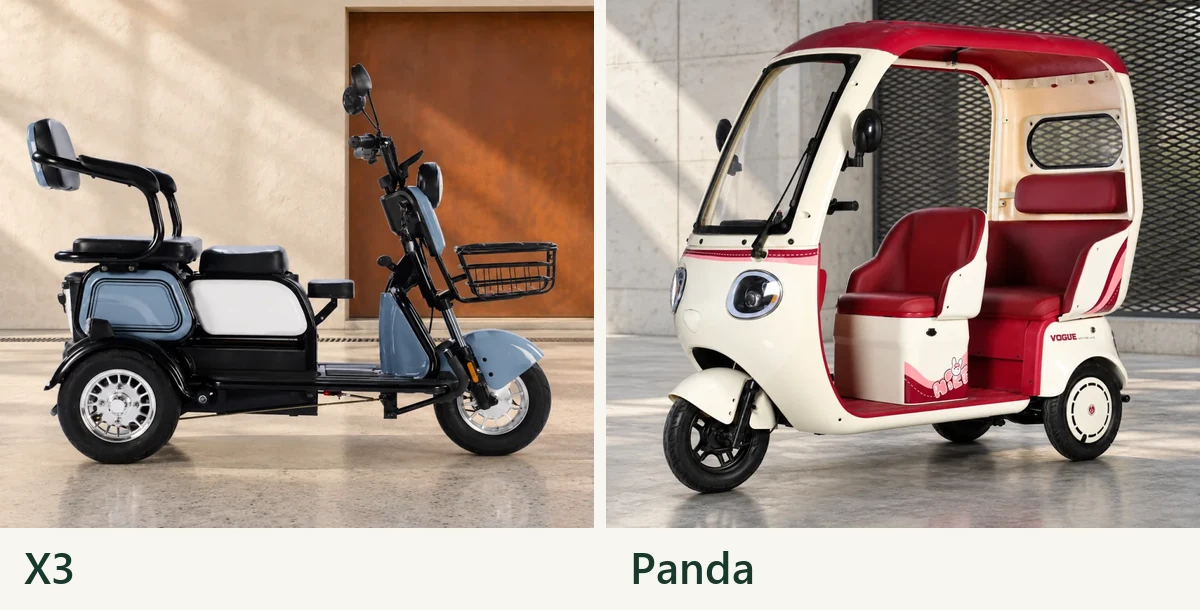
Which electric tricycle with a passenger seat fits your route?
For frequent short stops, look first at the route from the kerb to the rear seat. For a shuttle carrying bags, start by finding a place for the bags that leaves that route clear. The two motorized passenger tricycles below give a buyer different starting points for a sample inspection.
| Model | Layout | Sample check |
|---|---|---|
| X3 open tricycle | Open footboard, rear backrest and armrests, front basket and under-seat storage. | Measure the opening by the armrest. Try loading and retrieving a typical bag. |
| Panda canopy tricycle | Moulded front seat and padded rear seating under a canopy. Open sides. | Measure the side opening and headroom. Check foot space at the rear seat. |
If your route specification calls for a windshield, side panels or particular roof equipment, compare those separately in the canopy tricycle guide. Here the choice is about how passengers get in, sit and use the space.
How should a dealer measure the rear seating area?
Use the parked sample in its quoted seating configuration. Record three groups of measurements from the same side a passenger would use at the stop. Photograph the tape alongside its end points so another buyer can repeat each measurement on the delivered vehicle.
- Entry. Measure the first step up from level ground and the narrowest clear opening along the route to the rear seat. An armrest or a roof upright can reduce the opening even when the vehicle is wide.
- Seat. Measure usable cushion width between the inside faces of the fixed sides and usable depth up to the backrest. A dimension taken across the outside of the armrests includes space a passenger cannot use.
- Feet and bags. Check the foot space with the driver’s seat in the intended operating position. Put an example of the luggage carried on the route in its proposed storage space. Check whether retrieving it requires a passenger to move or step back into the boarding path.
These measurements answer different questions. A wide cushion can still be hard to reach through a narrow opening. A large basket also has limited value on a shuttle if the bag the operator carries most often does not fit through its opening.
What does a 400 kg load rating tell the buyer?
It is a model-level load entry. It does not describe the width, number or individual load limit of the seats. The X3 lists a bare weight of 78 kg and the Panda 200 kg, while each lists 400 kg load capacity. Enter bare weight, stated load capacity and designated seating positions on separate lines in the comparison. Confirm what the load rating includes for the quoted configuration before using it in a fleet specification.
For example, a request for one driver, one guest and a bag gives the supplier three things to account for. It does not establish that a particular vehicle is approved for that service. Ask for the seating layout and load information for the offered version. If permits or registration depend on seat count at the destination, use the documentation for that version when checking the local requirements.
What should go on the sample order?
Describe one ordinary stop in terms the receiving team can check. For the hotel example, the request could read:
Quote an open passenger tricycle for one driver and one guest boarding from the right-hand side at our property. Our usual bag is 45 × 30 × 20 cm. Please identify the intended seats and bag location on a side photo. Include the clear entry width, first-step height, seat width between the armrests and the load rating for this version.
The bag dimensions are an example. Substitute the operator’s actual luggage, boarding side and intended occupant arrangement. Attach the agreed photos and dimensions to the sample order. The receiving team can then check the seat hardware, storage access and boarding opening against the same reference if a different trim or body panel arrives.
Questions about passenger tricycle orders
Can an open passenger tricycle and a canopy model share one order?
BG EBIKE accepts mixed-model container orders with a flexible minimum by model. Give the quantity of each version when requesting a packing plan. The X3 lists a carton of 135 × 73 × 67 cm and the Panda lists 238 × 83 × 106 cm. Use those figures for freight planning. For unloading through a depot door, confirm the packed dimensions and orientation. For parking the vehicle in service, check its assembled dimensions.
Compare the electric tricycle range, then send the shortlisted model, boarding side, intended seating arrangement, quantity and destination.