
Seat height helps shortlist an electric moped, but seat width also affects how a rider reaches the ground. Two vehicles with the same quoted seat height can feel different to the same person. For importers and dealers, comparing scooter seat height and seat width together gives a better starting point for sample evaluation than ranking vehicles by one dimension.
Short answer: Seat height alone does not tell you whether a rider can reach the ground. A wider seat or footboard spreads the legs, so two mopeds with the same quoted seat height can feel very different. Compare seat height and seat width together, and confirm fit with a rider on the sample.
The purchasing question is specific: can the proposed model support the intended users’ seating and ground-reach needs? A catalogue measurement helps define that question; a sample assessment helps answer it for the people involved.
Seat height and ground reach describe different things
Seat height describes a vertical distance from the ground to the specified seat reference point. The quoted value needs its measurement conditions, including the seat position and vehicle loading state. Use the supplier’s definition rather than assuming every catalogue measures it identically.
A rider’s legs follow a different path: they pass around the front of the seat before reaching the ground. BMW Motorrad’s ergonomics explanation describes the relationship between seat height, front-seat width and the inner leg curve. A wider seat can require a longer path around it, even when the vertical seat height is unchanged.
This explains why one seat-height number cannot establish the same ground reach on two different vehicles. It also means that overall vehicle width is not a substitute for the width and shape of the seat where the rider’s legs pass.
Read the seat profile before drawing a fit conclusion
The Jaguar catalogue detail below shows a seat profile and its supporting structure. It is useful for identifying the seat being discussed with the supplier, but the side view does not show the front-seat width or provide a measured seat height.
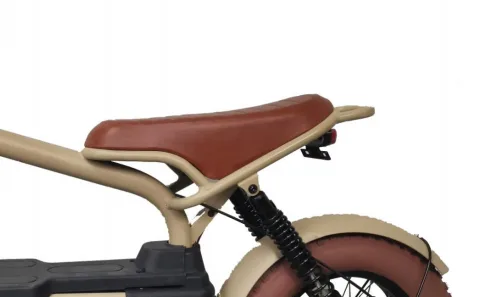
For a width comparison, identify the same relevant part of each seat. A maximum width near the rear and a width at the rider’s leg position answer different questions. A top view with a labelled measurement is more useful than an unlabelled “seat width” entry.
What two equal seat-height figures leave unresolved
Imagine a dealer reviewing two sample vehicles whose suppliers quote the same seat height. Sample A has a more tapered seat front; Sample B has a broader front profile. The equal height figures do not establish equal ground reach. The dealer needs to examine the seating position and compare both samples under consistent conditions.
This is an illustrative selection problem, not a test of BG EBIKE models. It does not establish that Sample A is more comfortable or more suitable overall. Ease of reaching the ground is one part of the evaluation; the intended riding position and the complete vehicle also matter.
| Comparison | Useful evidence |
|---|---|
| Vertical seat height | A labelled dimension with the seat position and loading state stated |
| Seat front and leg path | A top view identifying where the width is measured, followed by a sample observation |
| Ground contact for an intended user | A stationary assessment on the actual sample, recorded with the user and vehicle conditions |
Make the sample comparison repeatable
Compare shortlisted samples on level ground, with the vehicle safely supported and the drive system switched off according to its instructions. Use the same evaluator and footwear for the initial comparison. Record the model version, seat position, relevant vehicle settings and the evaluator’s seating position so a later review can reproduce the observation.
Describe what happened: for example, whether the evaluator could reach the ground from the intended seating position or had to move forward. Keep this observation separate from a general conclusion such as “suitable for short riders”. One evaluator’s result does not establish suitability for everyone of the same height.
If the dealer range is intended for users with different body proportions, include representative evaluators in the assessment. Record the observations individually. A universal rider-height-to-seat-height chart would hide those differences rather than resolve them.
Our sample evaluation guide explains how to connect findings to the proposed order version. If a seat or another relevant component changes after evaluation, carry that difference into the approval record.
A sample of the exact configuration is the quickest way to confirm these points, and model-specific changes are covered under customization.
Frequently asked questions
Why can two mopeds with the same seat height feel different?
Ground reach also depends on seat width, the shape of the seat front and the footboard. A wider seat spreads the legs and effectively shortens reach, so a rider may stand flat-footed on one moped and on tiptoe on another with the same quoted height. Compare the seat profile, not just the figure.
How should seat height be measured on a sample?
Measure from level ground to the lowest point of the seat top where the rider sits, with tyres at the correct pressure and the vehicle upright and unloaded. Record seat width at the front of the seat as well, and use the same method on every sample so the results are comparable.
Can the seat be changed on a moped order?
On most of our models the seat can be changed. Ask which seats are available for the model you are considering and how they change height and width, then confirm the chosen seat in the quotation so the bulk order matches the sample your riders tried.
Turn the finding into a useful model inquiry
Start with the models in the BG EBIKE seated scooter range or electric motorcycle range. Include the destination market, estimated order quantity and the seating or ground-reach requirement you need the sample to resolve.
A focused request might be: “We are comparing these two models for our dealer range. Please provide the seat-height measurement basis and a labelled view of the seat front. We would like to assess ground reach on the proposed sample configuration.” This asks for usable information without assuming an undocumented rider-height range.
Where getting on and off is also a priority, review the frame-layout guide alongside the seat comparison. Frame access and seated ground reach are separate parts of choosing a vehicle.