
Yes, an electric bike can be used in some snowy conditions, provided the bike and tires are suitable and you can control it on the route. Snow-covered pavement, deep snow and ice require different decisions. Motor power does not remove the need for grip when steering or stopping.
Short answer: Check 3 things before a snowy ride: the route surface, the tire setup, and the bike’s permitted operating conditions. Some snowy routes may be manageable with suitable equipment and experience, but avoid black ice, drifting snow and conditions in which you cannot see or maintain control. Fat tires alone are not evidence that a bike is suitable for ice.
For riders, the aim is to decide whether to ride, change the route or use another way to travel. For dealers, it is to explain winter-use requirements without treating every wide-tire model as a snow bike.
Which snow conditions should make you change your plans?
Judge the route, not just the weather icon. A forecast of snow does not describe every part of a journey. Check current conditions and local route-clearing information, including your return trip. The City of Toronto’s winter cycling guidance recommends planning an alternative route for snow or ice.
- Cleared pavement with snow alongside it: assess the usable riding surface, visibility and remaining hazards. Snow beside the path is different from snow covering the path.
- Snow-covered pavement: check whether you can identify a controllable route and whether the actual tire model is intended for those conditions. Do not assume that every white surface offers the same grip.
- Black ice or drifting snow: postpone or choose another way to travel. Bosch’s winter riding guidance specifically advises leaving both electric and conventional bicycles unused in these conditions.
- Deep snow: do not treat studded tires as a solution by themselves. Schwalbe’s winter-tire guidance identifies deep snow as a limit even for its spiked tires.
For example, a cleared street followed by an untreated path is not one uniform route. Check that path before deciding the journey is practical; a suitable first section does not settle the rest.
Are fat tires enough for snow and ice?
No. Width, tread and studs describe different aspects of a tire. A width marking tells you a dimension, not the conditions in which the tire has been evaluated. Look for the tire manufacturer’s intended-use information for the exact model, rather than relying on the bike’s “fat tire” label.
Schwalbe distinguishes coarse-tread tires for wet, cold or firm-snow conditions from spiked tires intended for ice. Its studded-tire range also lists different tread designs, compounds and sizes. Select the exact tire by its intended conditions and its fit to the vehicle.
A practical comparison asks three separate questions: what surface is the tire designed for, does it fit the wheel and vehicle, and is it suitable for the vehicle’s use? Resolve all three before changing tires. Our e-bike tire-size guide explains why a nominal wheel-size label does not establish fit.
Do not prescribe one “snow pressure” for every bike. Follow the permitted tire, rim and vehicle limits for the load carried. Lower pressure is not a substitute for an appropriate tire or a reason to ride a route you would otherwise reject.
How should you prepare the bike and adjust your riding?
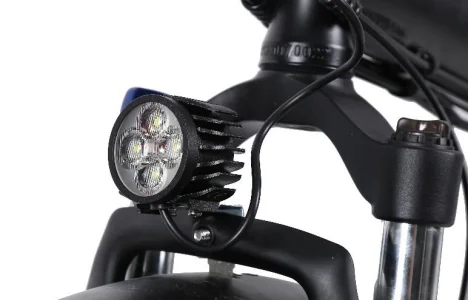
Check the brakes, tires, lights and controls before leaving. Confirm that gloves let you operate the controls properly and that clothing cannot catch in moving parts. Make sure you can see ahead and be seen. Toronto’s winter guidance highlights lighting and clothing clearance; advice published by the Met Office also stresses visibility and allowing more time.
Use smooth, restrained inputs rather than abrupt acceleration, braking or steering. Bosch warns against strong assistance when starting on snowy or icy paths because the driven tire can spin. Use the control instructions for your system; Bosch’s named assistance modes are not settings shared by every e-bike.
The Met Office guidance recommends slowing down and considering a different route or travel time to avoid ice. If visibility or control becomes doubtful, stop somewhere safe and reassess. Do not use the journey as a test of whether more motor assistance can overcome poor grip.
What needs attention after a snowy ride?
Remove salt and dirt using the cleaning method permitted for your bike, then inspect it before its next use. Bosch’s autumn and winter care guidance highlights cleaning away mud and salt. Follow the supplied instructions for electrical parts rather than directing a powerful water jet at them.
Keep riding, charging and storage limits separate. A battery that can power a bike in cold weather is not automatically ready to charge at the same temperature. Use the battery manufacturer’s charging conditions. Our cold-weather range guide covers the separate question of why winter distance can fall without proving permanent battery wear.
Models to compare
These models provide different configurations to discuss with BG EBIKE. The figures are listed product-page specifications, not a winter-performance ranking. Confirm tire model, permitted conditions and any proposed changes against the quoted configuration.
- 20 Inch Folding Fat Tire Electric Bike — listed 20 × 4.0 tires, a folding frame and Shimano 7-speed mechanical gearing. Include the exact tire specification in a seasonal-use inquiry.
- Brown Bear 20 Inch Fat Tire Electric Bike — listed 20 × 4.0 tires and a frame-mounted battery enclosure. The shared tire dimension does not establish identical tire construction or winter behaviour.
- 20 Inch Folding Electric Bike — listed 20 × 2.125 tires and 48V 10–25Ah lithium battery options. Use it as a narrower-tire configuration reference, not as proof of less or more ice grip.
Browse the electric bike range for other configurations. A useful dealer brief describes the expected surface and route, not just “winter use.”
If you sell to riders, our wholesale terms explain mixed containers and our flexible MOQ, and quality control covers inspection before loading and the one-year warranty.
Frequently asked questions
How many inches of snow can an e-bike handle?
There is no single snow-depth limit that can be applied to every e-bike. A depth figure alone leaves out the surface underneath, the tire setup, the bike’s clearance and the rider’s ability to control it. Do not convert a tire-width measurement into a snow-depth rating. Use the manufacturer’s intended-use limits and current route conditions.
Do new studded tires need a running-in period?
Check the instructions for the exact tire before its first winter ride. For example, Schwalbe’s winter-tire guidance calls for approximately 40 km on asphalt to help secure its spikes, avoiding forceful acceleration and braking during that period. This is a manufacturer-specific preparation step, not a universal distance or a reason to test grip on ice.
Are studded tires useful when most roads are clear?
Their value depends on the surfaces you expect to encounter, not simply the season. Schwalbe notes that its spikes can be used on normal roads but that the noise can become irritating when snow is rare and roads are mainly clear. Consider that trade-off alongside the exact tire’s intended use, vehicle fit and the conditions of your usual route.
Comparing models for a market with winter conditions?
Send your shortlisted models, destination, typical route surfaces and planned quantity. Include any tire or equipment requirements so the discussion concerns the complete configuration. Our MOQ is flexible by model, with mixed models allowed. We reply within 24 hours on working days.
Request a model and configuration quote