
The same hub output torque can produce different driving forces when wheel sizes differ. The distinction matters when an importer compares compact and larger-wheel e-bikes: a torque figure in newton-metres does not describe the forward push without considering the wheel.
Short answer: The same hub torque gives less push at the road on a larger wheel, because driving force ≈ torque ÷ wheel radius. For example, 40 N·m on a wheel with a 0.25 m rolling radius gives about 160 N, but on a 0.33 m radius only about 121 N. Compare torque together with the tyre-equipped wheel size, not torque alone.
This guide explains hub motor torque and wheel size using a simplified calculation. It helps dealers interpret specifications and prepare a useful sample comparison, rather than rank complete bicycles from one number.
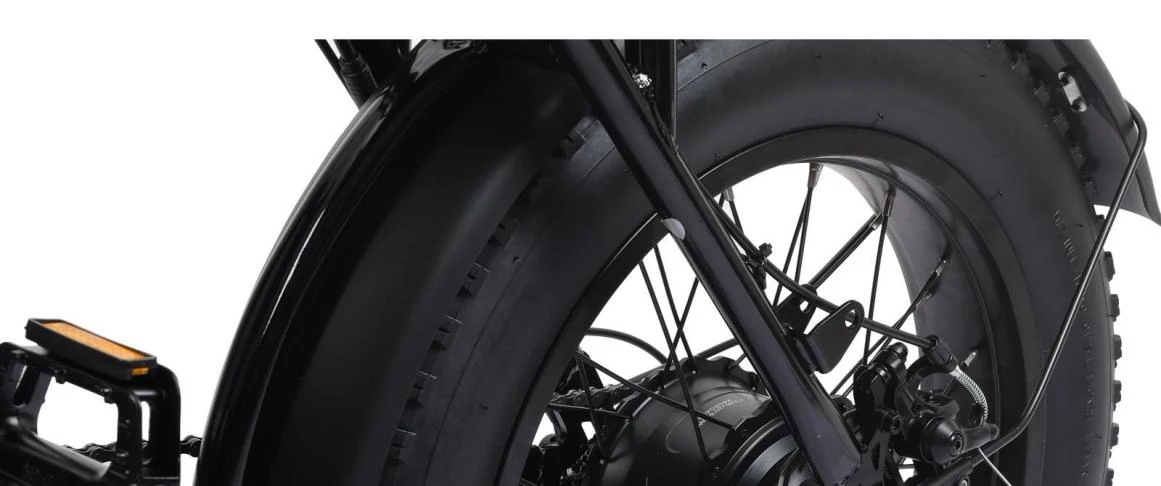
Separate hub torque from force at the road
Torque describes a turning effect and is measured in newton-metres (N·m). Driving force is measured in newtons (N). For a simple wheel model, the relationship is:
Driving force = wheel output torque ÷ effective wheel radius
F = T ÷ r, with T in N·m and r in metres.
Here, T means torque delivered to the wheel by the hub motor, after any internal motor gearing. It does not mean torque at an internal high-speed motor shaft, nor a mid-drive’s output at the crank. Those measurement locations need to remain separate.
The equation gives an idealised torque-equivalent force. It assumes adequate grip and neglects wheel rotational inertia and losses. It is useful for understanding leverage, not a complete prediction of acceleration.
Grin Technologies’ motor simulator explanation likewise separates hub torque from wheel thrust and explains that smaller wheels give more thrust for the same hub torque. Changing wheel size does not, by itself, increase the motor’s torque output.
A worked example: identical torque, different radius
Assume that each of two wheels receives 40 N·m of hub output torque at the operating point being compared. Give one an effective radius of 0.25 m and the other 0.35 m. These are teaching assumptions, not BG EBIKE measurements or exact conversions of catalogue wheel-size labels.
| Teaching example | Idealised force calculation |
|---|---|
| Radius 0.25 m | 40 N·m ÷ 0.25 m = 160 N |
| Radius 0.35 m | 40 N·m ÷ 0.35 m ≈ 114 N |
The smaller-radius example gives 1.4 times the calculated force, or 40% more, under those assumptions. The hub torque remains 40 N·m in both calculations. The difference comes from the shorter lever arm.
This result does not mean that a particular small-wheel bicycle has 40% better acceleration, climbing ability or range. Those are different outcomes, and the assumed torque may not be available at the same road speed on two real bicycles.
The same peak torque label is not the same operating point
A quoted maximum does not describe torque throughout a ride. Two systems carrying the same peak figure need not deliver that torque at the speed, battery condition or assistance setting relevant to your route.
At a given road speed, a smaller wheel rotates faster. With a fixed internal gear ratio, its hub motor also operates at a different rotational speed. Consequently, changing wheel radius changes more than leverage when comparing the actual behaviour of a motor system.
Grin’s technical explanation describes torque changing with speed and controller current limits, and separates short-duration operation from thermal limits. These are reasons to retain the operating conditions with a result. They do not establish the performance curve of an undocumented BG EBIKE configuration.
Use the tyre-equipped wheel, not just its catalogue label
The radius in the calculation concerns the complete wheel and tyre in use. A nominal size such as “20 inch” identifies a wheel or tyre category; it is not sufficient evidence of the exact effective radius for a force calculation.
Tyre size and construction, inflation and loading affect the wheel’s working dimensions. A comparison should state how the radius was obtained and keep the tyre and load conditions with it. For precise engineering work, the appropriate effective-radius definition and measurement method also matter; a casual photograph is not a measurement.
Do not halve a catalogue label and present the result as a measured radius. Our guide to reading e-bike tyre sizes explains why tyre and rim descriptions need to be read accurately.
A sample of the exact configuration is the quickest way to confirm these points, and model-specific changes are covered under customization.
Frequently asked questions
Does a bigger wheel make a hub motor weaker?
For the same motor torque, a larger wheel produces less pushing force at the road, because force equals torque divided by the rolling radius. The bike may climb a little less easily, while the same motor speed gives a higher road speed. Compare complete bikes at the wheel size you plan to sell rather than motors in isolation.
Is peak torque the figure to compare?
Peak torque is the maximum the system delivers briefly, usually at low speed. It does not show the torque available during a long climb, when the controller or motor temperature may limit output. Ask whether a figure is rated or peak, and at what speed it applies, before comparing two motors.
Should I use the rim size or the tyre size to calculate driving force?
Use the rolling radius of the wheel with its tyre fitted and inflated, because that is where the force meets the road. A 20 × 4.0 fat tyre has a noticeably larger radius than a 20 × 2.125 tyre on the same 20-inch rim, so the same motor pushes differently.
What this changes in a dealer’s model comparison
Compare the intended complete-bike versions before interpreting a torque difference. Wheel size is one part of the configuration, alongside the motor, controller, battery, tyres and permitted load. A compact bicycle and a larger-wheel bicycle can meet different customer needs even when one has a leverage advantage in a simplified calculation.
For a route with loaded starts or sustained hills, define the total operating load, gradient, distance and intended assistance use in the sample brief. Compare documented observations under comparable conditions, including whether the system can sustain the required operation. A brief start-up demonstration cannot establish continuous hill performance.
The sample evaluation guide helps connect those observations to the proposed production version. For the difference between hub and crank drive paths, see our motor-layout explanation; the wheel calculation here should not be applied directly to a mid-drive’s crank torque.
Choosing wheel sizes for your dealer range? Explore the BG EBIKE electric bike catalogue and send a sourcing inquiry with shortlisted models, destination market, estimated quantity and intended route and load. Include any wheel-size preference so the quotation and sample discussion address the complete configuration you need.