
Electric scooter ground clearance is a useful starting dimension, but it is not a maximum speed-bump height rating. The wheels change the vehicle’s position as they climb and descend an obstacle. Whether the underside touches depends on the obstacle’s shape, wheelbase, location of low components and the vehicle’s loaded condition.
Short answer: No. Ground clearance is the gap under the lowest point on flat ground, not a speed-bump rating. As the wheels climb an obstacle, the underside between them moves closer to it, so a long wheelbase or a low point mid-vehicle can touch a bump lower than the quoted clearance—especially with a rider and load on board.
For importers selecting seated electric scooters, this distinction matters when customers use raised entrances, parking ramps or roads with speed-control features. Compare the vehicle with the route geometry rather than selecting a model from one clearance number.
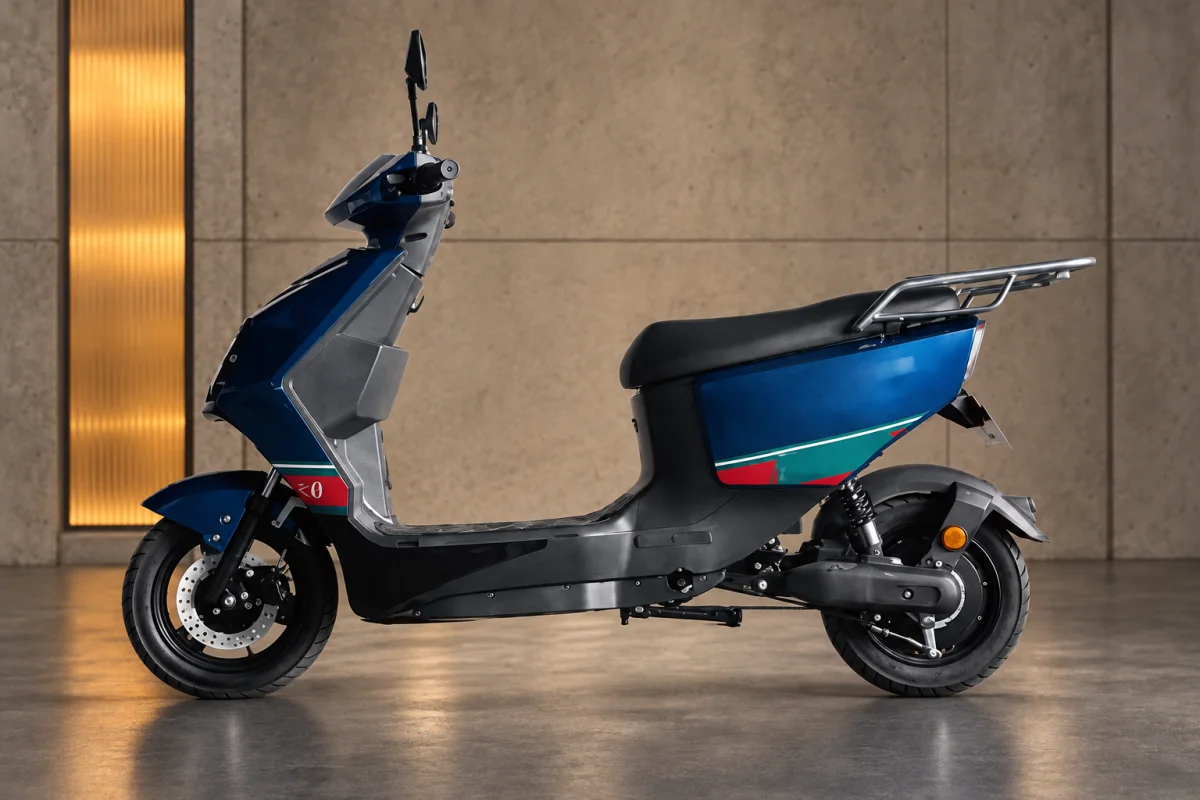
What a ground-clearance figure actually tells you
A clearance entry describes the gap between the ground and a specified low point under stated measurement conditions. Its value is most useful when the record identifies the vehicle configuration, loading condition and component measured. A floorboard’s upper surface is not the underside, and a side-view photograph is not a measurement record.
For example, the OG6 catalogue-based model record lists 12 cm ground clearance and a 124 cm wheelbase. Those entries describe two different dimensions. They do not establish the height or shape of a speed bump that the supplied vehicle can negotiate. OG6 is a different model from the OG5 shown above.
Why wheelbase and the low point matter
Imagine a raised crest between the two tyre contact points. A low component can approach the crest while the wheels sit on the road on either side. With other geometry held constant, increasing the distance between the wheels can reduce the space available over that crest.
This is the general geometry behind a breakover angle. Quigley’s explanation of approach, breakover and departure angles describes the relationship between wheelbase, clearance and low-hanging components for its four-wheel vehicles. The geometric distinction is useful here; its vehicle ratings and applications are not scooter specifications.
Simplified side view
Circles: wheels. Green line and projection: simplified underside. Orange shape: road crest.
The lowest point need not be at the middle of the wheelbase. A stand, mounting bracket or another low component may determine contact at a different stage of crossing. A single simplified breakover calculation cannot describe every part of a real scooter’s underside.
Two obstacles with the same height can pose different questions
The following comparison is illustrative, not a test result.
| Obstacle profile | What the height alone leaves out |
|---|---|
| A narrow raised crest | The crest may lie between the wheels while they remain lower on either side. |
| A broad raised platform of the same height | Both wheels may eventually stand on the platform; its entrance and exit transitions still need assessment. |
Once both wheels stand on a level raised platform, the whole vehicle has risen with it. On a narrow crest, the underside and wheel contact positions have a different relationship. This explains why comparing obstacle height directly with a flat-ground clearance figure is insufficient. It does not declare either obstacle safe to cross.
Compare the supplied vehicle in the relevant loaded state
Suspension and tyre deflection can change clearance when the vehicle carries a rider or cargo. A value measured without that load should not be presented as the remaining gap in loaded operation. The effect on a particular low component depends on its mounting and the vehicle’s geometry.
For a sample review, have the supplier identify the measurement basis and low components for the proposed configuration. Keep any route evaluation within the manufacturer’s instructions and permitted loading. Avoid treating a static gap as an allowance for impacts or suspension movement.
A useful purchasing brief describes the obstacle’s height, width along the route and entrance/exit profile, together with the intended load. That lets the discussion address a specific route instead of asking for a universally “high-clearance” scooter. There is no single clearance number in this guide that guarantees suitability for all roads.
Keep climbing power separate from this geometric question. A vehicle may have sufficient drive capability for an incline while a sharp transition presents a clearance problem. Our gradeability explanation covers slope percentages and angles; it does not establish underside clearance.
More guides for importers and dealers
- Electric Scooter Turns On but Won’t Move? A Dealer’s Fault-Finding Checklist
- Container Condensation in Electric Scooter Shipments: Why Dry-Looking Cartons Can Arrive Wet
- Lead-Acid vs Lithium Batteries for Seated Electric Scooters: A Dealer’s Buying Guide
- Electric Scooter Gradeability: 20% Grade Is Not 20 Degrees