
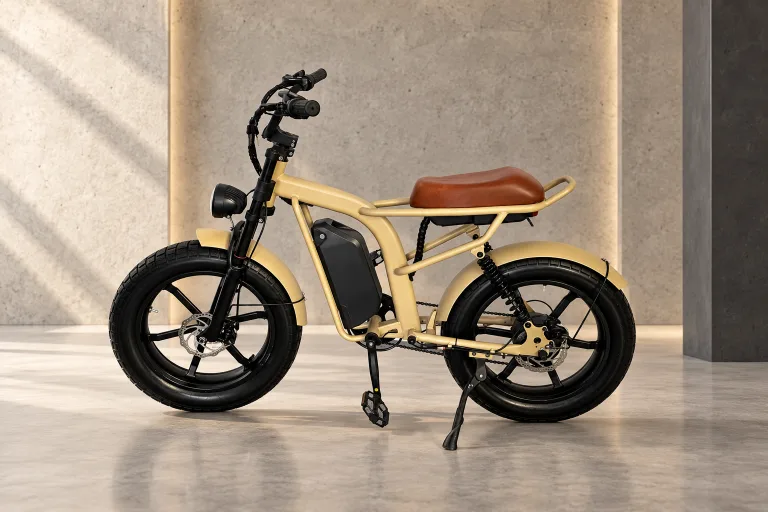
Some electric bikes use fat tires to make room for a larger air cushion and a tire setup suited to rough or soft surfaces. The useful question when buying is whether those benefits match your journeys: a bike for smooth streets and daily lifting has different priorities from one used regularly on uneven paths.
Short answer: Fat tires can absorb small surface irregularities and, with an appropriate tire and pressure, help a bike travel over soft or loose ground. For scale, BG EBIKE lists a 20 × 4.0 tire configuration alongside 20 × 2.125 and 20 × 2.5 configurations. The wider option is not automatically faster, longer-ranging or better for every rider; choose it for the route and the complete bike’s practicality.
What does a fat tire actually change?
A wide tire provides more room for air, but its behavior also depends on how it is built and inflated. Treat width as one part of the setup, rather than a performance rating.
More cushioning over small bumps
A large-volume tire can provide useful cushioning when operated at a suitable pressure. Schwalbe’s balloonbike explanation describes using the tire’s air volume for everyday riding comfort. That principle is relevant when assessing a rough cycle lane, but its named tire examples are not test results for BG EBIKE models.
The tire’s movement is limited. It does not replace the travel and damping of a suspension system, or turn a city bike into a mountain bike. On a test ride, separate the repeated vibration from a rough surface from the larger impacts you would normally avoid.
A setup for soft or loose surfaces
Large-volume tires designed for lower-pressure use can be useful on soft ground. As a component example, Schwalbe describes its Jumbo Jim fat-bike tire as intended for soft, rough and very loose terrain. This illustrates the purpose of the design.
Check the intended terrain of the complete bike and the exact tire. A wide street-oriented tire and a purpose-designed off-road tire should not be treated as interchangeable simply because both look substantial. Snow and ice also need a separate assessment; see our winter riding guide.
Do fat tires make an e-bike slower or reduce its range?
Width alone cannot answer either question. Rolling resistance—the energy lost as a tire rolls—depends on pressure, construction, tread, surface and size. Schwalbe’s rolling-resistance explanation shows why width needs context: with the same load and pressure, a wider tire has a wider, shorter contact patch rather than automatically a larger contact area. It can deform less in the rolling direction. This is not proof that every fat tire is more efficient.
The useful distinction is between width and the setup that width makes possible. A suitably designed wider tire can be used at a lower permitted pressure for an uneven surface, but fitting a wide tire and leaving every other variable unspecified does not establish more grip or less vibration. A coarse tread on smooth paving and a suitable setup on loose ground are different comparisons.
For a meaningful range comparison, use the complete configuration and comparable riding conditions. If two catalogued bikes also have different batteries, motors or equipment, their distance figures cannot isolate the effect of tire width. Ask for a comparison under stated conditions, rather than subtracting an assumed percentage for fat tires.
What are the practical trade-offs before buying?
The extra tire volume occupies real space. In the three BG configurations below, the second number in 20 × 2.125, 20 × 2.5 and 20 × 4.0 gives nominal tire width in inches: approximately 54 mm, 64 mm and 102 mm, respectively. These are unit conversions of listed sizes, not measurements of the fitted tires. They make the width difference easier to picture when shortlisting a wheel tray or storage slot; final fit still needs the actual tire and the accessory’s specified limits.
- Carrying and lifting: compare the complete bike’s weight and where you can hold it. A folding mechanism changes shape, not mass; a tire label does not tell you how manageable the bike will be on stairs.
- Wheel trays and storage slots: check the accessory’s permitted tire width and the bike’s other dimensions. A tray that accepts a narrower tire is not automatically suitable for a 4.0-inch configuration.
- Replacement supplies: confirm the tire and tube sizes your service channel can supply. A wider model should earn its place in a dealer’s range through a customer need, not just a different silhouette.
Weight deserves its own comparison. For example, the BG listings below give a bare weight of 41 kg for the 20 × 2.5 step-through model and 35 kg for the 20 × 4.0 Brown Bear. Those listed figures are not ready-to-ride weights, but they show why “wider tire means heavier complete bike” is an unreliable shortcut across different designs.
Which tire format makes sense for your route?
Start with the surface you ride most often, then account for the part of the journey that is hardest to manage.
Mostly smooth pavement, with stairs at home
Begin with manageable weight, rider fit and carrying equipment. Compare a narrower-tire option before paying attention to the fat-tire label. If the pavement already feels comfortable on a suitable setup, extra tire volume may solve little while the daily lift remains the deciding problem.
Frequent rough paving or uneven recreational paths
Include a larger-volume option in the shortlist. On a permitted test route, compare comfort and steering at an ordinary riding pace, with each bike correctly prepared for the rider. Choose based on the complete experience, including mounting, stopping and pushing the bike into its parking place.
Soft, loose ground as a regular destination
Start with a bike and tire intended for that terrain. A fat-tire format is worth considering here, but a city-oriented vehicle does not acquire an off-road use rating from its tire width. If the route is outside the manufacturer’s intended use, choose a different vehicle or route.
For a dealer, these examples suggest a better product comparison than simply offering “thin” and “fat.” Explain the customer job each configuration addresses. A folding commuter and a wide-tire leisure model need distinct reasons to be in the range, even when both share a nominal 20-inch size.
How should you approach tire pressure?
Use the permitted settings for the fitted tire, rim and bike; do not copy a pressure from a photograph or another fat-bike model. Schwalbe’s inflation guidance explains that load matters and recommends using a gauge rather than judging pressure by squeezing the tire. Stay within the applicable limits when adjusting for the rider and luggage. For the full method, use our e-bike tire pressure guide.
Lower pressure is not an unlimited comfort adjustment. Insufficient pressure can damage the tire, and a setting appropriate to one load may not suit another. For a model evaluation, record the tire model, pressure and load alongside the rider’s comments; otherwise, a comparison may reflect preparation differences rather than the design being assessed.
Models to compare
These three BG EBIKE product pages show different tire widths within a nominal 20-inch format. All figures below are listed specifications; confirm against the quoted configuration. The models differ in more than tires, so this is a shortlist comparison, not a controlled performance test.
20 Inch Folding Electric Bike
Listed tires: 20 × 2.125. Listed bare weight: 27 kg. Use this as the narrower-tire folding reference when storage and handling matter. Compare its actual folded size and ready-to-use weight with your access needs; the shipping carton is not the folded-bike measurement.
20 Inch Step-Through Electric Bike
Listed tires: 20 × 2.5. Listed bare weight: 41 kg. Its step-through frame, front basket and rear platform put everyday access and equipment into the comparison. It provides a width between the other two listings, but that does not make it a midpoint in weight or riding performance.
Brown Bear 20 Inch Fat Tire Electric Bike
Listed tires: 20 × 4.0. Listed bare weight: 35 kg. Use Brown Bear as the fat-tire reference, then assess the full frame and equipment arrangement against your intended journey. Its listed Shimano 7-speed gearing is another configuration difference; do not attribute every riding difference to tire width.
Browse the electric bike range for other configurations. For the separate task of reading markings and checking replacement fit, use our e-bike tire-size guide.
A sample of the exact configuration is the quickest way to confirm these points, and model-specific changes are covered under customization.
Frequently asked questions
Can I put fat tires on the e-bike I already own?
Only if the complete tire-and-wheel arrangement is supported for that bike. Matching the nominal wheel diameter is not enough: rim compatibility and clearance around the frame, fork and fenders also matter. Treat a change from a narrower tire to a fat tire as a fitment question for the exact vehicle, rather than assuming a tire from another model will fit.
Do fat tires let an e-bike carry a heavier rider or passenger?
No; tire width does not establish the complete bike’s permitted load or passenger capability. Use the vehicle’s stated limits and supported seating arrangement, together with the ratings of the fitted components. A wide tire cannot increase a frame or carrier limit. Include the rider, luggage and intended carrying setup when selecting a configuration, rather than using tire appearance as a load-capacity guide.
Does an electric bike need fat tires because it has a motor?
No; an electric bike can use a narrower tire format when the complete design and fitted components support its intended use. The BG examples above include both 20 × 2.125 and 20 × 4.0 configurations. Motor presence alone does not determine tire width. Choose the whole vehicle for the route, load and handling needs, rather than treating fat tires as compulsory electric-bike equipment.
Compare configurations for your customers’ routes
Send BG EBIKE your shortlisted models, typical route surfaces, storage or carrying constraints, destination market and planned quantities. We can discuss the quoted configurations around those needs. Our MOQ is flexible by model, with mixed models allowed, and we reply within 24 hours on working days.