
Short answer: Multiply the electricity measured at the outlet in kWh by the price per kWh. At USD 0.20/kWh, a 0.60 kWh session costs USD 0.12. Use the measured wall energy once; adding a separate allowance for charging losses would count them twice.
To work out how much it costs to charge an ebike, start with those two numbers. Battery capacity can help you estimate before buying, but the number printed on the battery is not a reading of the electricity you pay for. This guide shows both approaches, including partial charges and a monthly budget.
In this guide: Calculate one charge · Estimate from battery capacity · Calculate a month · Check your own usage · Use the result when buying
How to calculate the electricity cost of one charge
Charging cost = electricity used at the wall (kWh) × your electricity rate per kWh.
Example: 0.60 kWh × $0.20/kWh = $0.12, or 12 cents.
A kilowatt-hour is a unit of energy. The U.S. Department of Energy explains that electricity use over time is measured in kWh. It is different from watts, which describe power at a particular moment. A motor’s watt rating cannot tell you the electricity used during a charging session.
Use your applicable per-kWh rate, including any usage-based supply and delivery charges you are billed. A fixed monthly account charge that you pay regardless of charging is not an additional cost of that session. If your tariff has time-of-use prices, apply the rate for the charging period; the Department of Energy’s rate guide distinguishes these from flat rates.
This formula covers the energy charge billed per kWh. Public charging service fees, per-minute charges and commercial demand charges need separate treatment.
The table shows how the same charging session changes with the electricity price. All amounts are USD, and all rates and energy quantities are illustrative. These are neither national averages nor claims about a particular battery size.
Column headings are electricity rates; each cell shows the cost of that charging session.
| Energy used at the wall | $0.15/kWh | $0.25/kWh | $0.40/kWh |
|---|---|---|---|
| 0.30 kWh | $0.045 (4.5¢) | $0.075 (7.5¢) | $0.12 (12¢) |
| 0.60 kWh | $0.09 (9¢) | $0.15 (15¢) | $0.24 (24¢) |
| 0.90 kWh | $0.135 (13.5¢) | $0.225 (22.5¢) | $0.36 (36¢) |
If a meter reports that a session used 0.60 kWh, use that reading directly. It already includes the energy consumed upstream of the battery during that measured interval. Do not add a second percentage for charging losses.
Estimating before you have an electricity reading
Look for the battery’s stated energy in Wh. Where only nominal voltage and amp-hours are given, nominal V × Ah provides an approximate nominal-energy figure. For example, a hypothetical 48V, 15Ah pack is approximately 720Wh, or 0.72kWh. Use nominal battery voltage, not the charger’s output voltage. Our battery capacity guide explains these label differences.
Multiplying 0.72kWh by $0.20 gives $0.144. That is a capacity-only calculation, not a prediction of the electricity billed for a full charge. Energy is lost during charging, and the amount replenished depends on the starting charge level and the battery’s usable capacity.
The estimation method is: stored energy added during the session ÷ assumed overall charging efficiency × electricity rate. Use efficiency as a decimal, such as 0.90 for 90%.
As a separate top-up example, suppose a session adds 0.50kWh of stored energy and the overall wall-to-stored-energy efficiency is 90%. The estimated wall draw is 0.50 ÷ 0.90 = 0.556kWh. At $0.20/kWh, the cost is about $0.111, or 11.1 cents. This example is not the full-charge cost of the 720Wh pack above. The 90% value is an assumption for this calculation, not a universal efficiency figure or a BG EBIKE test result.
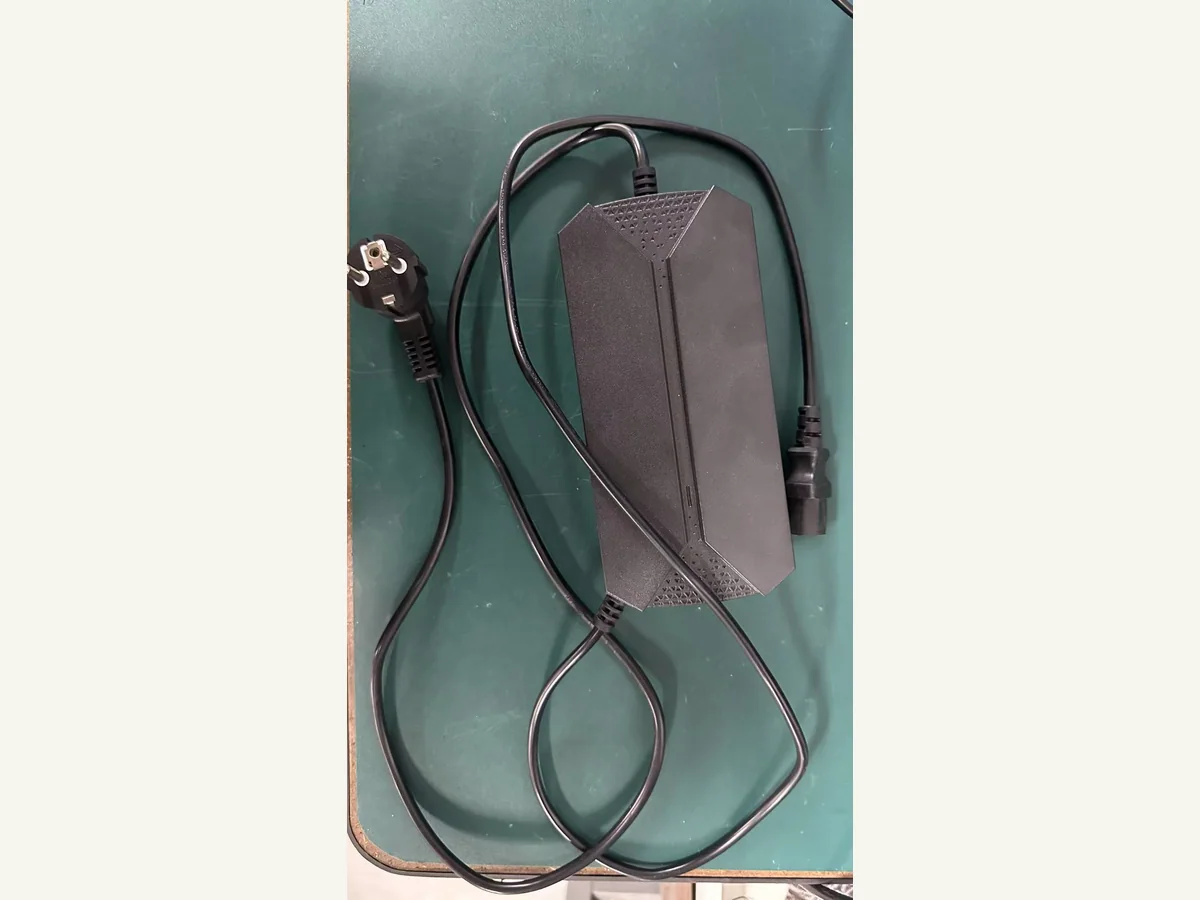
Without a documented efficiency value or a meter reading, label a capacity-based result as an estimate. A charger’s output-current rating alone cannot supply the missing information. The time needed to charge is a separate question covered in our 2A versus 4A charging-time guide.
What does charging cost per month?
Add the energy used during your charging sessions, then multiply by the applicable rate. At a flat rate, you can use a representative average per session if you keep a similar charging routine. When prices vary by time, calculate each session or time period at its own rate and add the costs.
Consider a rider who charges after 20 commuting days. In this illustrative example, each top-up uses 0.30kWh from the wall:
20 × 0.30kWh = 6kWh per month.
6kWh × $0.25/kWh = $1.50 per month.
If those 20 sessions instead averaged 0.60kWh, the monthly energy would be 12kWh and the bill would be $3.00 at the same rate. The difference is the energy replenished, not simply how often the charger was plugged in.
A top-up is not automatically a full charge
For a rough planning example, moving a nominal 500Wh battery from an indicated 30% to 80% suggests replenishing about half its capacity: 500 × 0.50 = 250Wh. This approximation excludes losses and assumes the displayed percentages represent energy proportionally. Treat it as a budgeting shortcut; a battery percentage display is not a utility meter.
You do not need to run the battery empty to estimate costs. Measure the charging routine you actually use. If you want a cost per mile, divide the charging cost for a recorded period by the miles ridden over a matching period with similar starting and ending battery charge. Do not divide by a catalogue’s maximum range and call the result your measured running cost.
How to check your own charging electricity use
A plug-in energy meter can record accumulated kWh for the charger. Use one suitable for your local supply and the charger’s input rating, following the meter and charging-equipment instructions. The value you need is energy in kWh, not a single instantaneous watt reading.
- Record the battery’s indicated starting charge and reset the meter’s accumulated energy reading.
- Charge using the manufacturer-approved equipment and normal charging instructions. Keep the meter connected for the charging session you intend to measure.
- At the intended completion point, record the ending charge indication and the accumulated kWh. End charging according to the manufacturer’s instructions.
- Multiply that kWh reading by the applicable rate. Repeat over several normal sessions if you want a representative monthly estimate.
Keep a simple record: date, starting and ending charge, wall kWh, electricity rate and calculated cost. If your measurement includes time after charging finished, identify that extra connected time rather than presenting it as energy needed solely to replenish the battery.
Cheaper off-peak electricity is not a reason to charge while asleep. CPSC advises staying present during charging, using the supplied or manufacturer-recommended charger, following the charging instructions and unplugging when done. For equipment selection, see our charger compatibility guide.
The battery is one of the largest items in a quotation — see how wholesale prices are built — and lithium-battery containers ship as dangerous goods, as explained in export packaging and shipping.
Frequently asked questions
How much does it cost to fully charge an e-bike battery?
Use a meter reading when available. For a planning example only, if a pack needs 500 Wh of stored energy and charging efficiency is assumed to be 90%, the outlet supplies about 0.56 kWh. At USD 0.20/kWh that costs about USD 0.11.
Is charging an e-bike cheaper than charging an electric car?
Per charge, much cheaper, because the battery is far smaller: an e-bike pack typically holds well under 1 kWh, while electric car batteries hold tens of kWh. For a fair comparison, use cost per mile from your own recorded charging and riding over the same period.
Does charging an e-bike overnight cost more?
Only if your electricity rate is higher at that time. On a time-of-use tariff, apply the rate for the hours you charge. A cheaper off-peak rate is not a reason to charge unattended while asleep; follow the charging instructions and unplug when charging is complete.
Use charging costs to inform a purchase, not to choose by one number
A smaller battery can cost less to replenish from empty without being the better choice for a rider’s route. Compare the intended riding requirement and charging access alongside capacity. A lower cost per full charge does not, by itself, prove lower cost per mile.
Electricity is also only one part of ownership cost. Keep the bike’s purchase price, servicing, tires, brakes and any future replacement battery separate from the charging calculation. This article estimates electricity spending; it does not promise a particular lifetime saving.
For a fleet tender, budget by vehicle group and shift. For example, 12 bikes charged once on each of 20 days at 0.60 kWh per session use 144 kWh. At USD 0.20/kWh the energy charge is USD 28.80. List demand charges or charging-service fees separately when the tariff includes them.
BG EBIKE’s electric bike range is a starting point for comparing vehicle configurations. Importers, distributors and brands can send a model and battery-configuration inquiry with their destination market, expected order quantity and customer use requirements. Any published charging-cost example should remain tied to its stated assumptions or a documented measurement of the selected version.