
Electric bike battery capacity is useful for comparing supplier quotes only when the numbers describe a specific battery version. A listing that says “20Ah” or gives a broad capacity range is not enough to establish what is included in an order.
Short answer: Compare nominal watt-hours alongside voltage and physical compatibility, rather than ranking batteries by amp-hours alone. Multiplying 48 V by 13 Ah gives 624 Wh, while 36 V by 15 Ah gives 540 Wh. These are nominal energy calculations, not range measurements or proof that the packs are interchangeable. BG EBIKE’s V1 lists a 48 V battery range of 10–25 Ah; each quotation should name the selected capacity instead of leaving that range unresolved.
Compare nominal voltage, ampere-hours and stated energy together, then match those figures to the quoted vehicle and battery version. This guide helps importers, dealers and brand buyers organise that comparison without turning a capacity calculation into a promise about riding range.
Read V, Ah, Wh and W as different specifications
| Unit | What it describes | How to use it in a quote |
|---|---|---|
| V — volts | Battery voltage; use the nominal value for a nominal-energy calculation | Record it with the exact battery version |
| Ah — ampere-hours | Charge capacity under specified conditions | Do not compare it alone across different voltages |
| Wh — watt-hours | Energy content | Distinguish manufacturer-stated energy from your calculated estimate |
| W — watts | Power, rather than stored energy | Keep the motor power entry separate from battery capacity |
For a general reference, the Bosch battery specification tables list voltage, Ah capacity and Wh energy content as separate fields. That is a useful way to organise a comparison; it does not imply that BG EBIKE models use Bosch batteries.
Check the units before calculating. If a supplier document prints “A” where a capacity might be intended, ask whether it means current or whether the unit needs correction. Do not silently change A to Ah. Likewise, a charging-voltage figure should not replace the battery’s nominal voltage in an energy estimate.
Compare nominal energy, not Ah alone
A simple estimate is nominal energy in Wh ≈ nominal voltage in V × capacity in Ah. It is a comparison aid, not a measurement of the usable energy delivered by a particular pack in service.
Consider two hypothetical quotations:
- Quote A: 36V, 15Ah. The calculated nominal energy is 36 × 15 = 540Wh.
- Quote B: 48V, 12Ah. The calculated nominal energy is 48 × 12 = 576Wh.
Quote B has fewer ampere-hours but a higher calculated nominal energy. This is why ranking these packs by Ah alone would give the wrong order for nominal energy. The examples are arithmetic illustrations, not available BG EBIKE options or a recommendation to replace a 36V pack with a 48V pack.
If the manufacturer’s stated Wh differs from multiplication of rounded catalogue values, retain both entries and ask for the rating basis. Do not overwrite the manufacturer’s specification with your own calculation.
Use a catalogue entry as a starting point
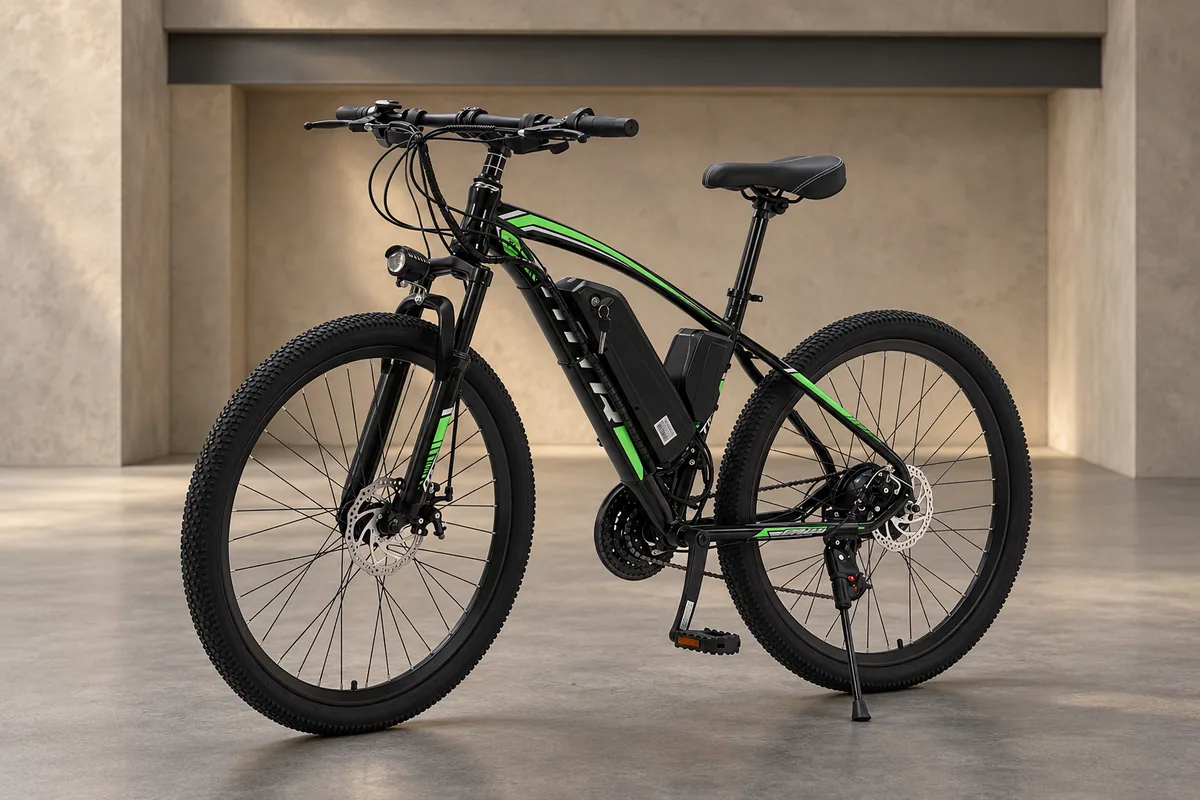
The supplied catalogue entry for the BG EBIKE 26 Inch Electric Mountain Bike lists a 36V 11Ah lithium battery. Multiplying those listed values gives approximately 396Wh of calculated nominal energy. This is not an independently measured pack result or a verified usable-energy figure.
For another catalogue example, the V1 model lists 48V and a 10–25Ah capacity range. The endpoints correspond to 480Wh and 1,200Wh of calculated nominal energy. That range is not the capacity of one supplied pack, and it does not establish that every intermediate capacity is offered. Use the selected pack’s V and Ah values in the quotation.
The source is the supplied product catalogue, slide 66, printed page 64. For an order, connect the entry to the selected battery version in the quotation. The photograph shows the vehicle and battery enclosure; it does not establish the electrical rating.
Turn a capacity range into a quoted version
A catalogue range describes the information available at model level. A purchase quotation needs a defined configuration. If a listing gives several capacities, ask which one the quoted price includes and how any offered alternative changes the order.
Keep the selected battery chemistry, nominal voltage, capacity, battery reference and matching charger together. Record whether the price includes the battery and charger, the number supplied per vehicle, and any version-specific equipment. A larger capacity printed elsewhere in the catalogue is not automatically included or available on the shortlisted model.
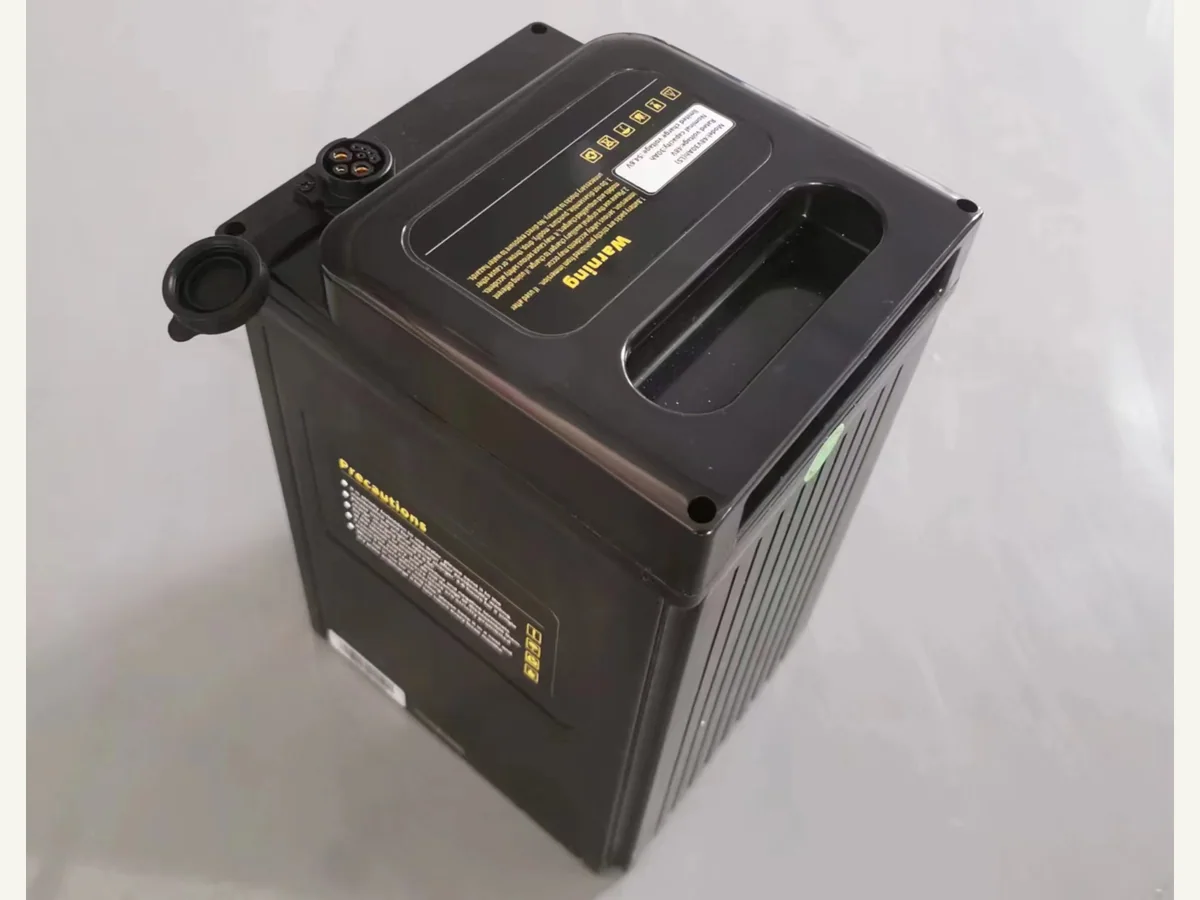
A photograph of a battery enclosure can support identification, but it cannot settle the version by itself. Request a readable label photograph or specification sheet tied to the proposed pack when the quotation is incomplete.
Build one battery comparison row per vehicle version
Use the same fields for every quotation so that an omitted specification remains visible:
- Vehicle and battery reference: model, selected version and the identifier used in the supplier’s documentation.
- Electrical ratings: nominal V, Ah and manufacturer-stated Wh. Put any calculated Wh in a separate field labelled “estimate”.
- Battery chemistry: the chemistry stated for that version, rather than an assumption based on the housing.
- Included equipment: battery quantity, matching charger reference and what the quoted vehicle price covers.
- Configuration differences: any offered capacity alternative, its price difference and associated changes to the vehicle or equipment.
- Evidence and revision: the dated quote, specification sheet and relevant label image used for the comparison.
This sheet is for comparing complete vehicle offers. It is not an interchangeability chart. Similar dimensions, voltage or capacity do not establish that two packs can be swapped between models; obtain model-specific compatibility information from the supplier.
Do not turn Wh into a guaranteed range
Stored energy and riding distance are different quantities. Actual consumption varies with the vehicle, assistance or drive mode, speed, load, route and conditions. Bosch’s Battery Guide treats energy capacity and range as related but distinct topics.
When range matters to your purchasing decision, request the conditions behind the quoted distance and compare like-for-like tests. A percentage increase in calculated Wh does not establish the same percentage increase in real-world distance, particularly when the vehicles or test conditions differ.
When you compare battery versions for an order, check the main wholesale price drivers and allow for dangerous-goods booking of lithium containers, covered in export packaging and shipping.
Frequently asked questions
What does Ah mean on an e-bike?
Ah means ampere-hours, a measure of charge capacity. Multiply it by nominal voltage to calculate nominal watt-hours for a comparison: 48 V × 10 Ah equals 480 Wh. For purchasing, record all three values together with the battery version. Ah is not motor output, charging power or a distance guarantee, and it does not establish replacement compatibility.
Should the highest-capacity option always be selected?
No. Select an offered battery version that matches the intended application, charging arrangements, vehicle specification and order budget. Compare its dimensions, mounting, connectors and compatible charger as well as energy capacity. Approve the chosen version on the sample record and quotation so that a bulk order cannot silently substitute a different capacity within a broad catalogue range.
Can equal Wh batteries be substituted for each other?
No. Equal nominal energy does not establish equal voltage or compatibility with a vehicle. Two packs can have similar Wh values but different voltage, housing, connector arrangement or control requirements. A dealer should identify replacement parts by the approved battery and vehicle references, then obtain the matching specification before adding replacement stock to the container.
Send a configuration-based inquiry to BG EBIKE
Include the model, destination market, estimated vehicle quantity and the battery configuration you want reviewed. If you are comparing versions, provide the V, Ah and Wh entries as written in each specification and identify any unclear units.
Review the 26-inch model’s 36V 11Ah specification and the V1 battery configuration range. For distance claims, use the separate range comparison guide rather than converting Wh into a promised riding distance.
Discuss your vehicle and battery configuration requirements. This inquiry concerns the battery configuration supplied with the relevant vehicle, rather than generic standalone battery retail.