
Electric bike charger compatibility should be established for the exact vehicle and battery version. A matching plug, similar casing or the same nominal battery-voltage label is not enough to approve a charger. For importers and dealers, the practical starting point is a manufacturer-approved charger reference linked to each battery configuration in the order.
Short answer: Use the charger approved for the exact battery: output voltage, current, connector and charging profile must all match the pack. A matching plug or similar case is not enough—a 48 V lithium battery, for example, needs a charger with about 54.6 V output. Record the approved pairing for each order version.
This guide explains how to request that information, separate input and output specifications, and maintain a usable pairing record for supplied equipment and aftersales replacements. It does not provide instructions for adapting connectors or selecting an unapproved substitute.
Start with an approved pairing, not a generic product description
The U.S. Consumer Product Safety Commission warns that a charger marketed as universal may physically fit a micromobility product while remaining incompatible. Its charger guidance advises using the supplied charger and contacting the manufacturer about tested and approved replacements.
For a purchasing team, this means asking the vehicle supplier to identify the approved charger for the selected battery version, rather than treating “e-bike charger” as a complete specification. Keep that reference in the quotation and order record. If an alternative is offered, request its explicit approved application and supporting information.
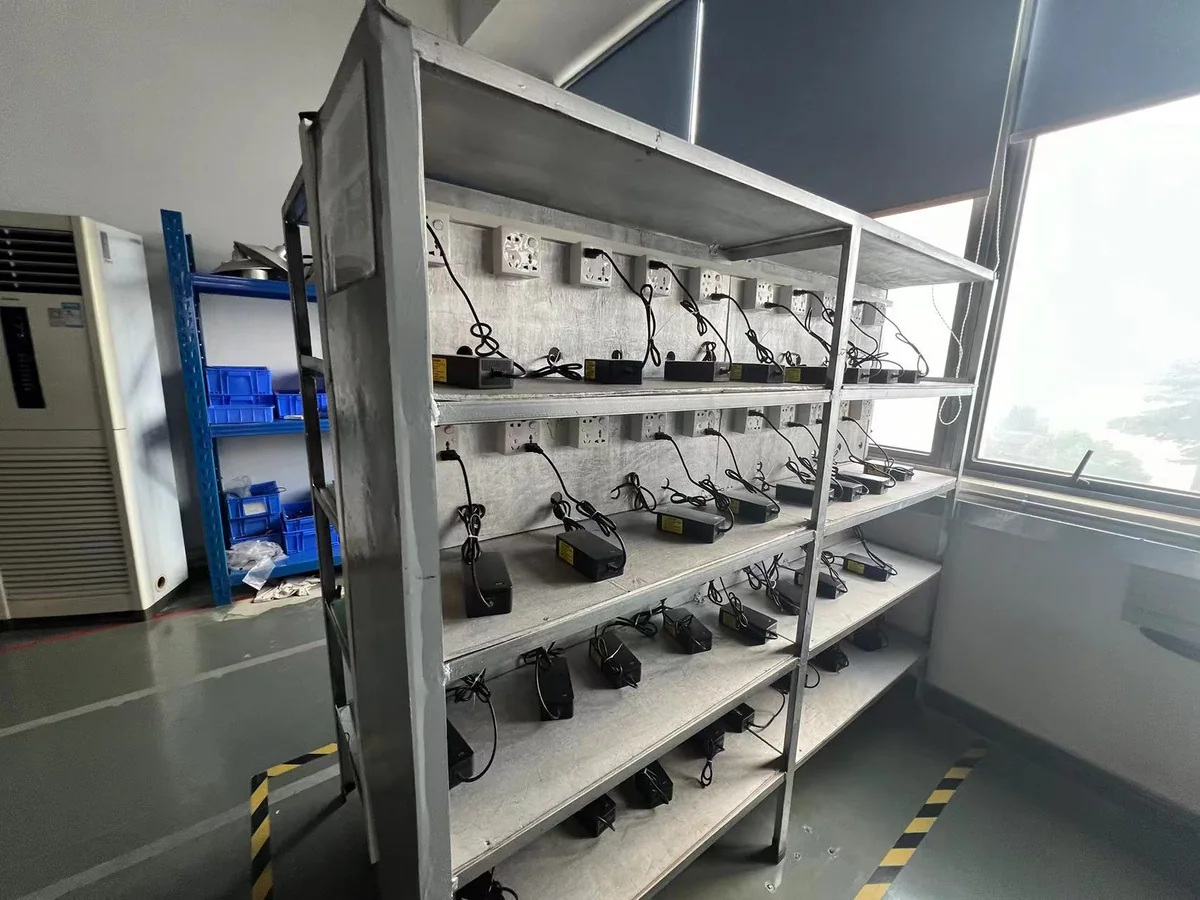
Keep the approved charger reference with the battery version in the order record. The shelf photograph below shows equipment storage; the charger label and model-specific pairing record are needed for an electrical specification.
Keep charger input, charger output and battery data separate
Input describes the electrical supply the charger accepts. For the destination market, request the stated input voltage and frequency range, together with the supplied mains lead and plug. A plug photograph alone does not establish those electrical ratings or which market versions are available.
Output describes what the charger supplies to the battery. Record the exact output label and charger model reference. Keep these fields separate from the battery’s nominal voltage and capacity; do not copy a battery-voltage figure into the charger-output field or infer the missing value from it.
Battery identification links the equipment to the intended pack and vehicle version. Ask for the battery reference and the manufacturer’s matching instructions. Numerical ratings help identify equipment, but they are not a substitute for the approved pairing.
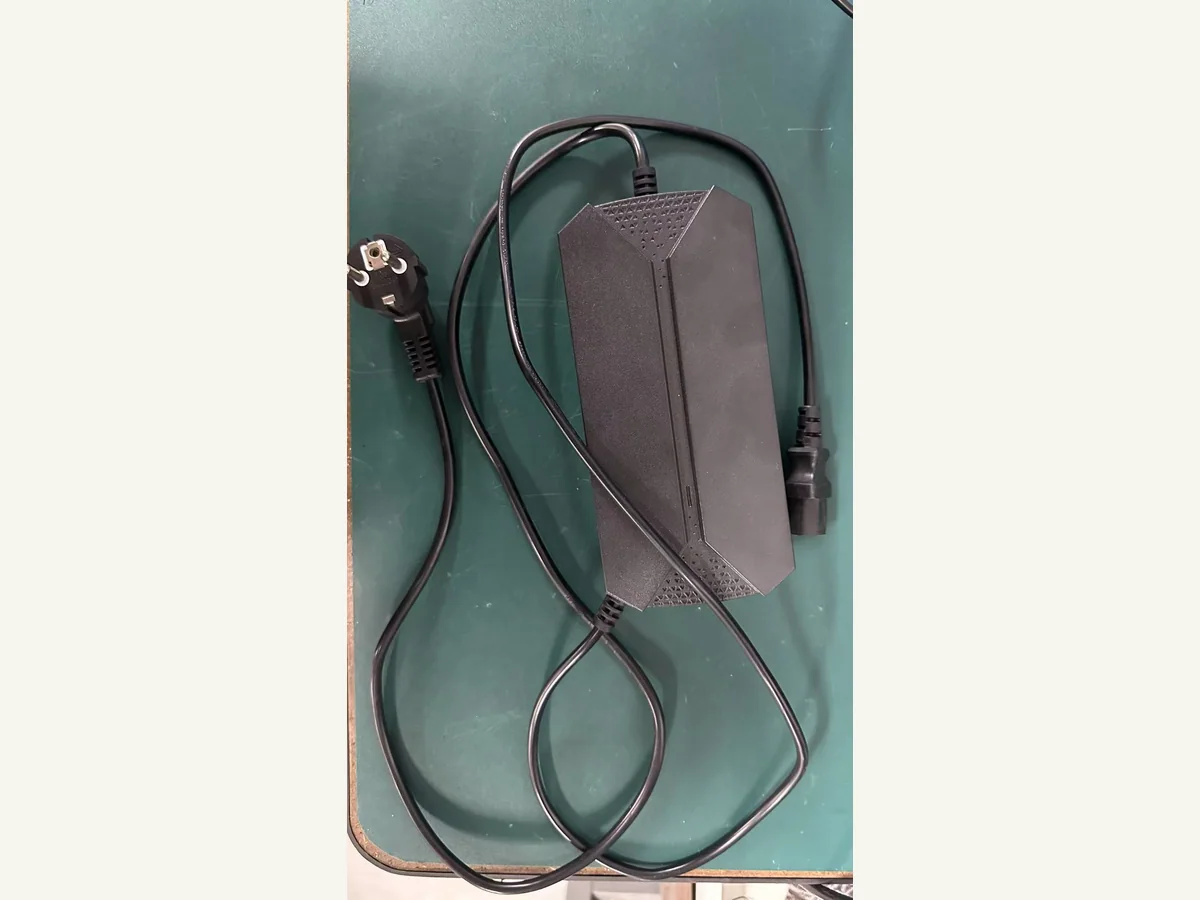
For the charger shown below, request a legible specification label and output-connector details with the approved battery reference. The casing and mains plug alone do not provide that information.
Record the connector without assuming it proves compatibility
Request a clear image of the output connector and the mating charging port, plus the supplier’s connector identification. Where needed for the technical record, ask the manufacturer for its documented contact arrangement and polarity. Do not infer these details from a connector’s outer shape.
Keep any communication or system-specific matching requirements in the same record when the manufacturer specifies them. This is information to obtain from the supplier, not a prompt to open the equipment, probe contacts or change wiring.
A complete charger record should therefore identify both the hardware and its approved application. A connector photograph is useful for recognising a part during receiving or service, but it does not authorise substitution.
Build a charger pairing record for each order version
Use the following fields for each vehicle-and-battery combination. The record supports identification and order control; it is not an independent electrical compatibility test.
| Record field | Information to request and retain |
|---|---|
| Vehicle and battery | Vehicle model/version, battery reference and relevant configuration revision. |
| Approved charger | Charger manufacturer/model reference and supplier documentation identifying its approved battery application. |
| Input supply | Input voltage and frequency range, mains lead and destination plug supplied with the order. |
| Output specification | Readable output label and documented charging ratings; do not substitute battery nominal values. |
| Connection details | Connector/port photographs, identification and any manufacturer-specified polarity or communication requirements. |
| Included equipment | Chargers per vehicle, included cables and any separately quoted approved spare units. |
| Instructions | Operating and charging instructions for the supplied equipment and intended market. |
| Change and service record | Approved replacement reference, version restrictions and process for reviewing a proposed substitution. |
Ask for a readable label photograph rather than a distant workshop image. If the supplier uses an internal reference that is absent from the casing, retain the document connecting that reference to the actual labelled product. Keep unresolved fields visible until the supplier provides the information.
Manage similar-looking versions before shipment
Two vehicles with the same model name may be quoted with different battery configurations. Do not assume their chargers are shared. Conversely, do not create unnecessary separate stock references if the manufacturer documents one charger as approved for both configurations. The pairing record should determine how the equipment is identified and supplied.
For example, a dealer ordering two battery versions can request two pairing entries, even if the charger photographs look identical. If the supplier confirms a common approved charger, record that shared application. If the references differ, keep the packing and aftersales identification distinct. This example describes a recordkeeping method, not a claim about specific BG EBIKE versions.
At sample review and receiving, compare the labelled charger reference, supplied lead and quantity with the approved order record. Refer a discrepancy back to the supplier before treating the equipment as an acceptable substitute. A basic visual check can detect a mismatch in documentation; it cannot validate an undocumented electrical pairing.
Carry the same information into aftersales support
For a replacement request, collect the vehicle/version reference, battery label and original charger label. Add the order or serial reference where available. This helps the supplier identify the approved replacement instead of relying on a photograph of a black charger casing.
Keep dealer-facing records separate from customer instructions. Staff need the version and replacement references; customers need the correct supplied equipment and its operating instructions. Do not present a generic charger as interchangeable across the range or promise a faster charging option without model-specific approval.
Questions to resolve before ordering
Are e-bike chargers universal?
Do not treat them as universal. Establish the approved charger for the exact battery and vehicle configuration, including any replacement application documented by the manufacturer.
Does a higher current rating automatically make a charger an upgrade?
No. A rating alone does not establish approval for a battery system. Ask whether the supplier offers a documented alternative for the exact version, and request its operating conditions rather than promising a shorter charging time.
Is a USB charging socket the same as the battery charger?
No. A USB accessory charging outlet and the equipment used to recharge the vehicle’s main battery serve different functions. Identify them separately in the parts and supply records.
Discuss charger supply with BG EBIKE
Send the vehicle model, selected battery version, destination market and estimated quantity. State whether you need the standard supplied charger information or an approved model-specific spare reference. Include existing label photographs if the request concerns an earlier order.
Start from the vehicle’s battery configuration, such as the V1 specification, and request its approved charger reference. For an existing order, use our after-sales information and provide the original model and battery identifiers.
The battery is one of the largest items in a quotation — see how wholesale prices are built — and lithium-battery containers ship as dangerous goods, as explained in export packaging and shipping.
Frequently asked questions
Can I use any charger with the same voltage on my e-bike?
No. A charger must match the battery’s nominal voltage, chemistry, connector and charge profile, and should be the model approved for that battery or bike. Two chargers with the same voltage can still have different end-of-charge voltages, current limits or pin layouts, so a plug that fits does not prove the charger is compatible.
Can a faster charger damage an e-bike battery?
It can if the battery is not specified for that charging current. A higher current adds heat and stress to the cells, so only use a higher-amp charger that the battery maker approves for that exact pack. Our 2A vs 4A charger guide explains how much time a faster charger actually saves.
Which charger plug and input does each destination market need?
The charger’s mains input and plug must suit the destination: for example 230V with an EU or UK plug, or 110–120V with a US plug. Confirm the input range and plug type in the quotation for each battery version, so every shipped e-bike arrives with a charger that fits local sockets.
Request model-specific charger and supply details. The inquiry should identify the complete vehicle configuration; this guide does not imply universal charger availability or standalone retail compatibility.