
Yes, you can put a higher-capacity battery on some electric bikes, but only when the replacement is approved for that exact bike and system. Matching voltage, a familiar connector or a case that fits does not establish compatibility. First identify an approved replacement; then compare the extra energy, weight, cost and charging needs.
Short answer: Yes, if the manufacturer approves a higher-capacity pack for your exact bike. Keep the same nominal voltage, mount and approved charger. Stored energy rises with watt-hours: a 48V 15Ah pack (720Wh) holds 50% more than a 48V 10Ah pack (480Wh), although the real range gain depends on route, load and assistance level. A different-voltage or “universal” pack is not a direct replacement.
This guide is for riders considering more range and dealers handling that request. It separates a supported battery change from a modification that needs a different technical assessment.
What does a “bigger battery” mean?
Three different changes can hide behind that phrase:
- More capacity: more ampere-hours (Ah) at the same nominal voltage, or more stated watt-hours (Wh). This is the relevant comparison when seeking more stored energy.
- Higher voltage: for example, replacing a 36V pack with a 48V pack. That changes an electrical system requirement; it is not simply a capacity upgrade.
- A larger housing: extra length, width or height. Physical size alone tells you neither the energy content nor whether the pack works with the bike.
Start with the battery label and the bicycle’s exact model and version. Use the Ah and Wh comparison guide if the ratings are unclear. Do not use the charger’s output voltage as the battery’s nominal voltage.
Decide which replacement situation you have
The useful question is not “Does this battery look compatible?” It is “What identifies this pack as a supported replacement for my bicycle?” Use the following distinctions before ordering.
| What you have | What to do |
|---|---|
| An official higher-capacity replacement listed for the exact bike version | Check its required hardware, charger and fitting instructions. Follow the specified owner or dealer installation route. |
| A larger battery offered on a new version of the same model | Check whether the offer also covers your existing bike. A factory option does not by itself document a retrofit. |
| A seller claims “same voltage,” “same plug” or “universal fit” | Treat compatibility as unconfirmed. Obtain the bicycle manufacturer’s approval for the identified pack before connecting it. |
| The proposed pack has a different nominal voltage, or needs improvised wiring or mounting | Do not treat it as a direct replacement. Return to a supported battery option rather than testing the modification on the bike. |
The U.S. Consumer Product Safety Commission advises using replacement or secondary packs tested and approved for the device, with suitability confirmed by its manufacturer. This is stronger evidence than a seller’s compatibility claim.
Check the complete fit, not just the battery label
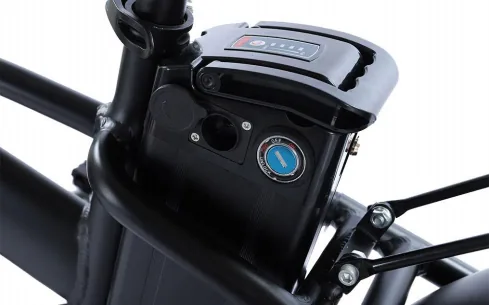
Mounting, locking and removal
A pack must work with the specified holder and retention mechanism, not merely occupy the available space. The approved fitting instructions should identify any required rail, cover or fastening parts. Also check the space needed to remove the pack: a battery can sit inside a frame opening yet be obstructed by the saddle or accessories during removal.
For a concrete example, Riese & Müller’s battery replacement guidance says a Bosch PowerTube 625Wh-to-750Wh change needs individual checking because length, connections and system approval differ. This example concerns its stated systems; it is not evidence that a BG EBIKE model accepts either pack.
Electrical system and charger
Use a replacement reference tied to the complete bike system, including its controller and any battery communication requirements. A matching nominal voltage is only one specification. A matching connector shape does not document the electrical connections or system compatibility behind it.
Keep the charger decision attached to the battery decision. CPSC recommends the charger supplied or recommended by the device manufacturer. Reuse an existing charger only when it is specified for the replacement pack and bike; buy a different charger only when that pairing is supported. A bigger Ah number is not permission to choose a higher-current charger.
How much extra energy would you get?
Consider an illustrative comparison, not an available BG EBIKE upgrade: a 48V 10Ah battery and a 48V 15Ah battery. Using nominal voltage × Ah:
- 48 × 10 = 480Wh of calculated nominal energy.
- 48 × 15 = 720Wh of calculated nominal energy.
- The difference is 240Wh, or 50% more nominal energy.
That calculation compares energy ratings; it neither approves the swap nor promises 50% more riding distance. Usable energy and consumption matter. A different route, load, assistance setting or temperature can change the result. Keep the comparison on the same bike and use the conditions in our e-bike range guide when evaluating a distance claim.
More Ah at the same voltage is also not a motor-power or top-speed specification. If your aim is more speed, a capacity comparison does not answer that request.
Is the supported upgrade worth choosing?
Once compatibility is documented, compare the actual benefit with daily use. Does the current pack fall short on your normal route, or only on an occasional longer trip? Compare the approved options’ total price, stated weight, removal access and charging arrangements. More capacity can be useful, but a pack that is harder for you to carry upstairs may be a poor trade.
Check the specified charging time for the proposed pack and charger. Do not assume the existing charging window remains sufficient, or that a faster charger is permitted. Include any required fitting parts and dealer work in the price comparison.
If there is no approved larger replacement, check whether the manufacturer supports a spare pack that is exchanged according to its instructions, or a specific range-extender system. These are different arrangements. Approval for a spare pack does not authorize connecting two packs together.
Prepare a replacement request that can be answered
Send the manufacturer or its authorized service contact this short identification set. It gives them something specific to confirm rather than a photograph and “Will this fit?”
- The bicycle: exact model, version or model year, and frame/serial identifier where requested.
- The current equipment: readable battery and charger label photographs, including their part numbers. Include the installed mounting arrangement without opening the pack.
- The proposed replacement: its exact part number and capacity, not only a marketplace title.
- The desired answer: whether that pack is approved for this bike, what hardware and charger it requires, and who may install it.
A useful confirmation links the bike, pack and fitting requirements. “We sell a larger battery” leaves the central question unanswered. Save the confirmation with the parts reference so that a later replacement follows the same documented configuration.
Battery version and charger change the quote, so see what drives e-bike and scooter wholesale prices, and how lithium batteries are packed and documented in export packaging and shipping.
Frequently asked questions
Can I use a higher-voltage battery on my e-bike?
Not as a simple upgrade. Moving from 36V to 48V changes the electrical system that the controller, display and charger are designed for. Only fit a different-voltage pack if the bike manufacturer offers it as an approved configuration with the matching parts; otherwise stay with the specified nominal voltage.
Will a bigger battery increase my e-bike’s range?
It increases stored energy, and range usually rises with it, but not always in exact proportion. A 48V 15Ah pack holds 50% more watt-hours than a 48V 10Ah pack; the real gain depends on route, rider load, assistance level, temperature and the extra battery weight.
Can I use my existing charger with a larger battery?
Only if it is specified for the new pack and bike. A charger for the same nominal voltage can still be unsuitable for a different battery’s connector or charge profile. Check the approved charger listed with the replacement pack before you charge it.
Choosing battery capacity for a new BG EBIKE order
For importers, distributors and brand buyers, selecting the required battery configuration before ordering is a separate decision from upgrading a customer’s existing bike. Describe the intended route, charging access and carrying needs when comparing our electric-bike range.
Send BG EBIKE a vehicle configuration inquiry with the shortlisted model, destination market and estimated quantity. Have the selected battery and charger identified in the offer.