
A charging symbol on a map can mean a car charging cable, an ordinary power socket, or a dedicated e-bike charging point. Before making it part of your route, identify which service is actually available and what equipment you need to bring.
Short answer: Sometimes—but a car charging connector cannot normally plug directly into an e-bike battery. Check 3 things: the outlet or supported battery system, the equipment required, and permission to use the location. A permitted, suitable mains outlet can supply your bike’s matching charger; a dedicated e-bike charging cable must support your exact battery system.
What kind of charging point have you found?
The useful distinction is what the facility supplies at the connection you will use. A large power rating on the sign does not answer that question.
1. A car charging connector
Car charging equipment uses vehicle interfaces such as J1772, CCS or NACS/J3400. These are not ordinary household sockets or the small output connector on your e-bike charger. The U.S. Joint Office’s connector guide distinguishes car charging interfaces and explains that NACS can serve both AC and DC charging. The connector name alone therefore does not describe every aspect of the supply.
For a conventional e-bike, a car charging cable by itself is not a usable charging stop. A mains-powered bicycle charger cannot be plugged straight into a car connector. Treat a proposed adapter arrangement as a separate compatibility question, discussed below.
2. A normal mains outlet at the location
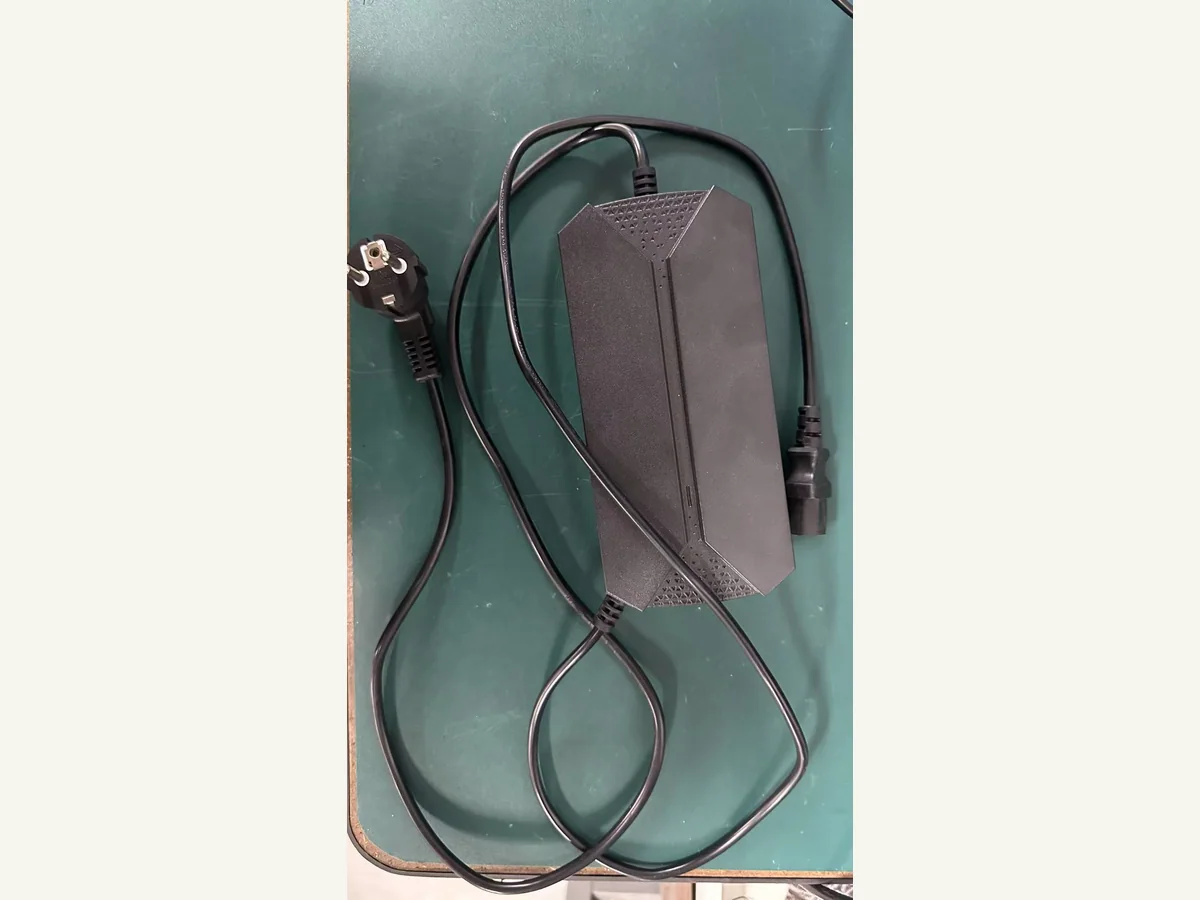
This can be useful if the operator permits e-bike charging and the supply suits your own matching charger. Bring the charger and its appropriate mains lead; the outlet supplies AC power, while the bicycle charger provides the controlled DC output required by its matching battery.
There is a real distinction even within one charging site. Manningham Council’s public-charging brochure describes separate standard 10A outlets for e-bikes at selected locations alongside car DC chargers, with no cable provided. This Australian example shows why the site’s e-bike provision must be checked separately; it does not establish availability at every location or today’s operating status.
3. A dedicated e-bike station
Check whether it provides ordinary sockets, built-in charging cables, or both. Built-in cables may serve named battery systems rather than every bicycle. For example, Spelsberg’s BCS Pure station lists Bosch and Shimano connections as well as separate 230V Schuko sockets. The integrated cable and the socket are two different ways to use that equipment.
If your battery system is not listed for the built-in cable, a compatible, permitted mains outlet with your own charger may still be an option. Do not select a charging lead simply because its plug looks similar.
What should you check before leaving home?
- Identify the actual connection. Look for a socket photograph or a list of supported battery systems. “EV charging available” is too broad to plan around. Ask whether the e-bike facility is separate from the car cable.
- Match the equipment and location. Read your charger’s input label and instructions. Confirm supply voltage, frequency, plug type and permitted environment; battery labels such as 36V or 48V describe a different part of the system. The Bosch BCS210/BCS230 manual, English page 9, requires the supply to match the charger nameplate. Apply the instructions for your own equipment.
- Confirm access before relying on the stop. Check opening hours, operating status, permission, any required access method and where the bike may stand. A socket behind a locked door or beside a restricted parking bay may not be available to you.
A useful message to the host is: “Do you have an outlet where I may use my own e-bike charger? What supply and socket does it provide, where can the bike stand, and is the point available during my visit?” For a station with built-in cables, add your exact battery system and ask whether it is supported.
Which of these stops could you actually use?
- A car park listing only a tethered car connector: it does not yet provide a confirmed way to use your ordinary e-bike charger. Do not count it as a charging stop merely because the map marks it as an EV station.
- A venue with a permitted mains socket: this can be a usable stop when the supply matches your charger’s input requirements, the charger is approved for that environment, and the bike can stand safely while you remain with it. Bring the charger matched to your battery.
- A dedicated point with built-in bicycle cables: it can serve your bike only if it supports the exact battery system. “E-bike charging” describes the service, not universal compatibility. A separate mains outlet, if provided and permitted, is a different option.
The practical distinction is whether you have a complete, supported path from the site’s supply to your battery. A location name or charging symbol alone does not provide that path.
Can an adapter make a car charging point work?
Do not assume that changing the plug is enough. For an AC car charging point, an adapter proposal must address the station interface, the electrical supply delivered to your charger, and the equipment makers’ permitted use. The bicycle charger is still required to charge its matching battery.
Before including such an arrangement in a trip, obtain support for the exact station, adapter and charger combination from their manufacturers and confirm the site operator permits it. A video of another rider charging successfully does not establish those conditions for your equipment. A DC fast-charging connector is not a mains socket and must not be connected directly to a conventional e-bike battery.
For an ordinary charging plan, choose a confirmed e-bike point or permitted mains outlet that works with your supplied equipment. Our charger compatibility guide covers the separate charger-to-battery checks.
Will a powerful car charging station charge the bike faster?
Its advertised power does not establish the charging speed of your bicycle. When your own charger is supplied from a suitable mains outlet, the approved charger and battery combination still determines charging behavior. Moving the same equipment to a location with a high-power car charger does not turn it into a faster battery charger.
For example, a car DC charger and an ordinary socket beside it are separate connections. The power printed on the car unit is not the power your bicycle receives through its charger at the socket. Plan the stop around your equipment’s charging guidance, the battery’s starting charge and the time you can remain there. Avoid relying on an unverified stop as the only way to complete the route.
Models to compare
For public charging, compare the charger you must carry and the space you need at the stop. The following are listed BG EBIKE product-page features; confirm the battery, charger and charging access against the quoted configuration. These layout comparisons do not establish compatibility with a station’s built-in cable.
26 Inch Electric Mountain Bike
Start with the correct charging equipment. This model lists a 36V 11Ah down-tube battery, while the two models below list 48V options. If travelling with a group or ordering a mixed fleet, identify each bike’s matched charger before leaving: a shared mains outlet is not a reason to swap battery-side chargers. At the stop, check access to this bike’s charging connection in its parked position.
20 Inch Folding Electric Bike
Check whether the parking arrangement works before connecting. The listed folding layout and 48V 10–25Ah battery options suit a different planning question from the non-folding layouts: will the chosen stationary arrangement fit the host’s permitted space while leaving the charging connection accessible? Compare actual folded dimensions with that space if folding is needed. Establish the position first, and disconnect before folding or moving the bike.
20 Inch Step-Through Electric Bike
Try the stop with your everyday luggage. This model lists a front basket, rear platform and 48V 10–25Ah battery options. For an errand route, check how the charger is carried and where it can be placed under its operating instructions. With bags fitted, make sure the charging connection remains reachable and the lead is not trapped or stretched across a walkway. Matching the folding model’s voltage and capacity options does not establish a shared charger.
The electric bike range can help you compare those layouts. A workable public-charging plan requires both a confirmed supply at the destination and a practical arrangement for the specific bike, charger and luggage you bring.
Battery version and charger change the quote, so see what drives e-bike and scooter wholesale prices, and how lithium batteries are packed and documented in export packaging and shipping.
Frequently asked questions
Can I leave the bike charging while I go shopping?
Plan to supervise charging rather than leaving the equipment unattended. Bosch’s battery safety guidance calls for supervised charging in a dry, ventilated environment. A public location does not remove your own equipment’s care requirements. Before starting, choose a stop where you can remain nearby and follow the charger instructions; do not assume that a locked charging compartment provides active monitoring.
Does an outdoor station mean my charger can stay outside?
No. The station’s outdoor installation does not establish that your portable charger is suitable for outdoor use. Check the charger’s own instructions and the conditions at the charging position. The Bosch BCS210/BCS230 manual cited above labels those chargers for indoor use. A canopy, plastic bag or dry-looking pavement does not change an equipment restriction; arrange a permitted location before connecting.
Can a USB socket at a charging point recharge the main battery?
Only if the bike manufacturer explicitly provides for that charging method. Do not confuse a USB outlet for phones or accessories with the connection used to recharge the bicycle’s main battery. Identify the main charging port in the supplied instructions and use the specified equipment. A USB socket on a station, display or bicycle does not by itself make USB charging of the traction battery available.
Choosing charging equipment for your market?
When ordering bikes for customers, specify the destination market and the supplied charger for each battery version. Include the expected charging location and any battery-access requirements in the model discussion. BG EBIKE’s MOQ is flexible by model, with mixed models allowed. We reply within 24 hours on working days, and a PDF catalogue is available on request.