
Electric bike brake types can be easy to misread in supplier quotations. “Disc brake”, “dual disc” and “hydraulic” do not describe the same feature. For importers, dealers and brand buyers, the useful comparison is the complete front and rear configuration supplied with a specific vehicle version.
Short answer: E-bikes use rim brakes, disc brakes and, on some city models, drum or roller brakes, and each can be mechanical or hydraulic. “Disc”, “dual disc” and “hydraulic” describe different things, so record the brake type and actuation for both front and rear on the version you are quoted.
Record the brake mechanism at each wheel, how it is operated, and the component references. A label such as “front and rear disc brakes” does not, by itself, establish hydraulic operation or a measured stopping distance.
Separate brake type from actuation
Start with where friction is applied. A disc brake uses pads acting on a rotor; a rim brake acts on the wheel rim; a drum brake uses friction surfaces inside a drum. These descriptions identify the mechanism, not a universal performance ranking. This guide focuses on reading disc-brake specifications, with other types included to help identify different entries in a quotation.
| Quotation wording | What it tells you | What it leaves open |
|---|---|---|
| Disc brake | The wheel uses a disc rotor and caliper | Actuation, component model and rotor specification |
| Front and rear disc brakes | Both wheels are listed with disc brakes | Whether the front and rear systems use the same components or actuation |
| Mechanical disc brake | A cable operates the disc-brake mechanism | The specific lever, caliper and compatible rotor |
| Hydraulic disc brake | Fluid pressure operates the disc-brake mechanism | The specific assembly, fluid specification and service requirements |
| Front disc / rear drum | The two wheels use different brake mechanisms | The detailed specification of each assembly |
Keep the terminology in two fields: mechanism and actuation. Hydraulic is not another word for disc. Hydraulic actuation is used with both disc brakes and rim brakes, so write down both the brake type and how it is operated when comparing models.
Mechanical vs hydraulic disc brakes: compare the supplied assembly
A mechanical disc system transmits the lever action through a cable. A hydraulic disc system transmits pressure through fluid in a hose. That distinction matters when a dealer identifies replacement parts, workshop documentation and the equipment needed to support the chosen model.
For an example of how a component manufacturer separates these systems, TEKTRO provides distinct mechanical and hydraulic disc-brake manuals, together with model-specific parts information. Use the documentation for the actual supplied components; this reference does not imply that BG EBIKE vehicles use TEKTRO brakes.
Do not approve a quotation simply because one label sounds more advanced. Ask the supplier to identify the complete front and rear assemblies, then evaluate those assemblies against the vehicle brief and the support available in your market. A component change should be documented as a different quoted configuration, rather than treated as an automatic upgrade available on every model.
Use product photographs to locate parts, not fill missing specifications
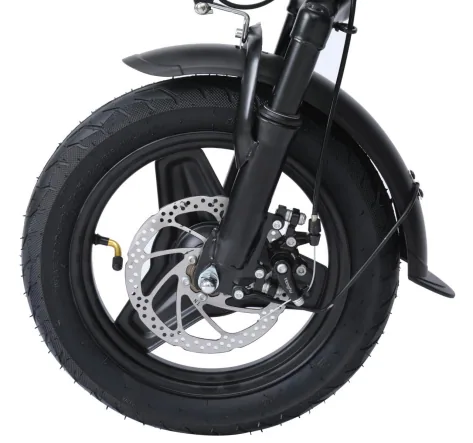
The Z6 front-wheel reference below shows the rotor and caliper area. It helps a buyer point to the component they are discussing. It does not provide a complete brake specification or prove the equipment supplied in a future order.
The V1 rear-wheel reference shows another model and another wheel position. Read it separately from the Z6 image: these are not photographs of one vehicle’s front and rear system. A close-up can support a question about a component, but the exact assembly reference should come from the selected vehicle’s documentation.
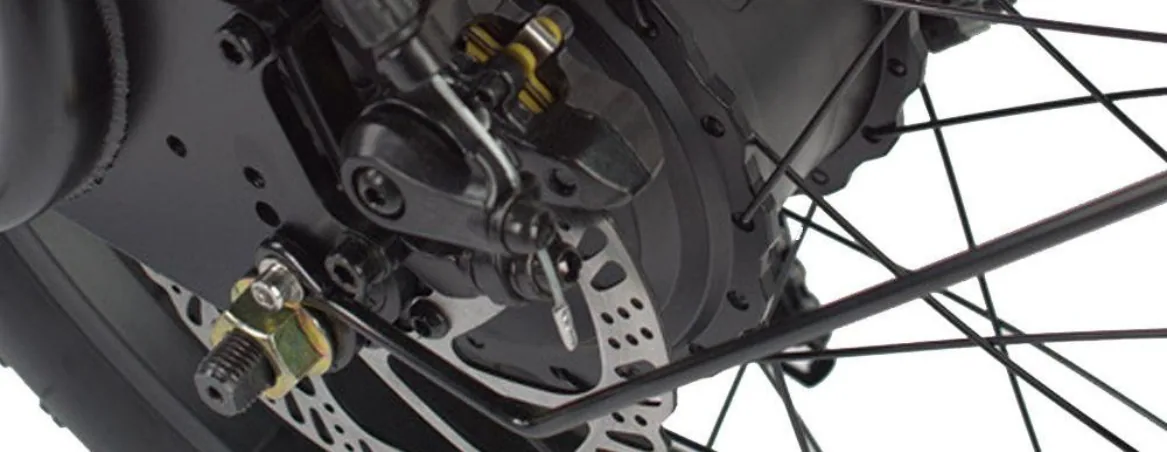
Do not infer rotor diameter, pad material, piston count or electrical brake functions from an incomplete photograph. Likewise, a “hydraulic” entry in a suspension row describes suspension; it should not be copied into the brake field.
A brake specification checklist for supplier quotes
Create one record for each vehicle version under consideration. Keep the front and rear entries separate, even if the catalogue groups them together:
- Vehicle reference: model, configuration identifier and quotation revision.
- Front brake: mechanism, actuation and supplied assembly or component reference.
- Rear brake: the same fields, recorded independently of the front.
- Disc details where applicable: manufacturer-stated rotor dimensions and the matching caliper and pad references. Leave an unlisted value blank rather than estimating it from a picture.
- Controls and interfaces: matching lever and any explicitly specified electrical brake function. Request its description rather than treating a wire or connector as proof of a particular function.
- Service information: component manual, replacement references and any model-specific consumables or tools required by that manual.
- Quotation scope: the configuration included in the price and any offered alternative, with its associated component changes listed.
This is a configuration record, not an installation checklist. It helps your purchasing and workshop teams discuss the same equipment without assuming that similarly named parts are interchangeable.
Compare evidence before ranking two configurations
Suppose Quote A says “dual disc”, while Quote B says “hydraulic disc”. Quote A identifies a front-and-rear arrangement but leaves actuation unspecified. Quote B identifies an actuation type but may leave wheel coverage and component references unspecified. Neither description alone is a complete basis for comparison.
Return the missing fields to each supplier in one request. Once both records describe complete configurations, your team can compare price, documented equipment and service requirements on the same basis. If braking performance is part of the purchasing decision, request relevant test evidence and its conditions rather than deriving a stopping-distance claim from the brake label.
Keep vehicle categories distinct. A seated electric moped’s brake specification should not be treated as interchangeable with a pedal bicycle’s system simply because both list disc brakes. Product-category names and component labels do not establish destination-market approval.
A sample of the exact configuration is the quickest way to confirm these points, and model-specific changes are covered under customization.
Frequently asked questions
Does “dual disc” mean hydraulic brakes?
No. In a vehicle listing it commonly describes discs at both wheels, while hydraulic describes actuation. Where the wording is ambiguous, ask for explicit front and rear entries rather than treating the phrase as a complete specification.
Does the same rotor diameter mean the parts can be shared?
No. Diameter is only one field in a component specification. Use the manufacturer’s matching references for the supplied assembly before planning shared replacement stock.
Should every catalogue field be complete before shortlisting a model?
A shortlist can include models with open questions. Keep those fields visible and resolve the configuration needed for your order before accepting the quotation. An omission is a request for more information, not evidence that the vehicle has or lacks a particular feature.
Request a configuration-specific vehicle quotation
Send BG EBIKE your shortlisted model, destination market, estimated vehicle quantity and the brake requirements your team needs reviewed. Include an existing specification or annotated product reference if it helps identify the front or rear assembly in question.
The Z6 folding model and 26-inch electric mountain bike both list front and rear disc brakes. Their listings do not establish hydraulic actuation; request the complete front and rear assembly specification for the version you intend to buy.
Discuss your vehicle configuration requirements. Keeping the brake specification with the model and quoted version makes the inquiry more useful than asking for “better brakes” without a defined configuration.