
Shipping marks and the packing list should let the receiving team connect each physical package to its expected contents. For mixed e-bike orders, that connection needs to distinguish the model, colour, configuration and any separately packed equipment. Counting the correct total number of cartons is only the first step.
Short answer: Carton marks identify each package; the packing list says what is inside it. On a mixed e-bike order, every carton mark should map to one packing-list line with model, colour, configuration and quantity, and separately packed batteries, chargers or accessories should reference the vehicles they belong to. A correct carton total alone can still hide a wrong mix.
A useful receiving question is: “Which order line belongs in this package, and where is the rest of that line packed?” This guide uses an illustrative shipment to show how to answer it before a mixed order reaches the warehouse.
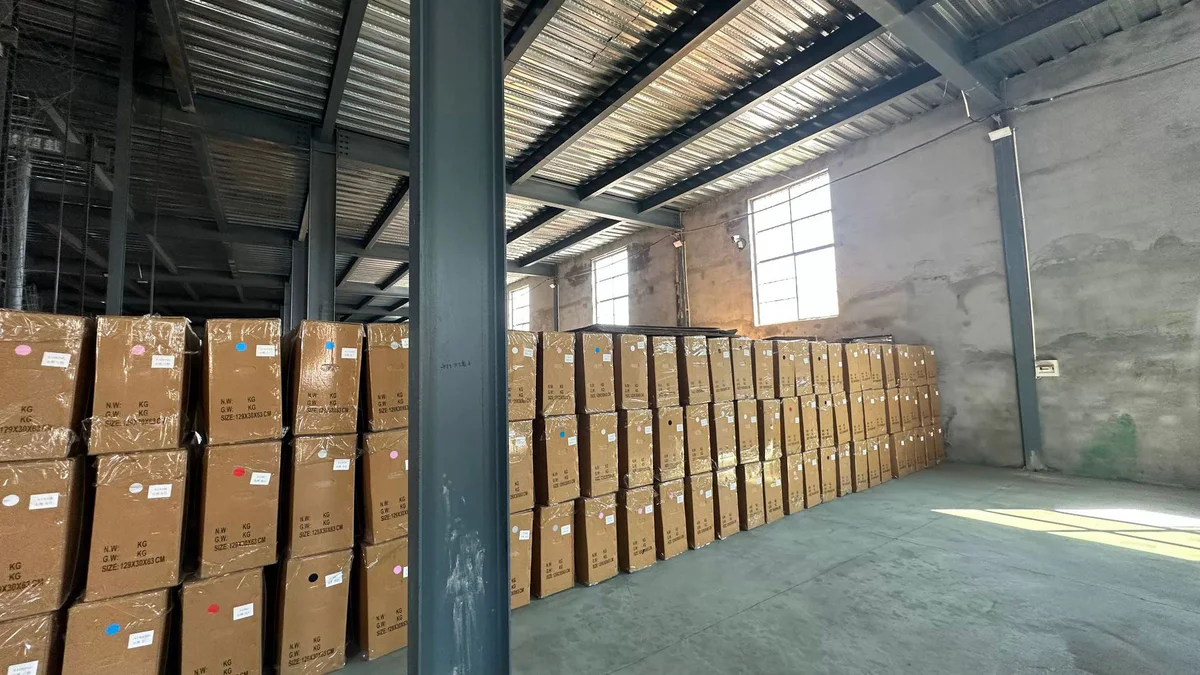
Carton marks identify packages; the packing list describes their contents
An exterior identifier gives staff a reference they can read on the package. The packing list provides the shipment breakdown behind that reference. The U.S. International Trade Administration’s export-document guide describes quantities, package types, package counts and marks among the information in an export packing list.
For an e-bike order, a model name alone may leave colour or configuration unresolved. Agree the descriptions used by purchasing and the receiving team, and link them to the accepted specification. Do not rely on a coloured sticker unless its meaning is documented for that shipment.
The example below is a receiving aid. It is not a complete customs-document template; the documents and markings needed for a particular shipment should be agreed with the relevant importer and logistics parties.
Worked example: 60 bicycles in 62 cartons
Illustrative assumptions: order DEMO-01 contains 60 bicycles. Each bicycle occupies one carton, and its equipment kit is packed separately. Two additional cartons contain the 60 kits. Model A, Model B and configuration codes R1/R2 are fictional references, not BG EBIKE model specifications or a standard packing arrangement.
| Carton IDs | Expected contents | Quantity | Order connection |
|---|---|---|---|
| DEMO-01 / 01–20 | Model A, blue, R1 | 20 bicycles | Order line 1 |
| DEMO-01 / 21–40 | Model A, black, R1 | 20 bicycles | Order line 2 |
| DEMO-01 / 41–60 | Model B, black, R2 | 20 bicycles | Order line 3 |
| DEMO-01 / 61 | Model A / R1 equipment kits | 40 kits | One per bicycle in lines 1–2 |
| DEMO-01 / 62 | Model B / R2 equipment kits | 20 kits | One per bicycle in line 3 |
The package count is 62 cartons. The vehicle count is 60 bicycles. The kit count is 60 kits. Adding the kit quantities to the bicycle quantities would not produce a meaningful vehicle total.
The order reference makes the carton sequence specific to this shipment. Carton “21” on a later order must not be confused with DEMO-01 / 21. A range is useful only when its packages share the stated contents; exceptions need their own entry.
Why a correct total can hide a wrong mix
Suppose receipt checks establish 21 blue Model A bicycles, 19 black Model A bicycles and 20 Model B bicycles. The total remains 60, but the agreed colour allocation is wrong. Comparing the received quantities with the three order lines reveals one extra blue unit and one missing black unit.
The next step is to identify the affected package and record the observed contents against the expected entry. A label that says “black” does not prove a black bicycle is inside. Keep the observed finding separate from the label description and seek resolution through the agreed supplier process.
For the earlier decision about quantities per model, colour and configuration, see our MOQ and order-mix guide. The example here addresses identifying and reconciling an accepted mix.
Link separately packed items to the vehicles they belong to
Cartons 61 and 62 are different kit groups in the example. Treating them simply as “accessories” would lose the connection to the intended model and configuration. The contents record should identify the kit reference, items included and allocation to the relevant order lines.
This is particularly useful when equipment is counted separately from vehicles. It does not establish that a kit, charger or mounting component is interchangeable between models. Any approved shared application needs its own model-specific reference.
Keep packaging identity separate from vehicle identity. A carton number locates a package in a shipment; a vehicle serial number identifies a particular vehicle. Where serial records are provided, connect them to the appropriate package or order line without treating the two identifiers as equivalent.
Update the labels and list together after a packing change
If a carton is repacked, a shipment is split or an equipment allocation changes, review the affected identifiers and contents entries together. Retain one current packing-list revision and distinguish superseded versions. Otherwise the warehouse may compare the goods with a document that was accurate before the change.
Barcodes can support that connection when the receiving system and supplier use an agreed scheme. GS1’s logistics-label explanation shows how its SSCC identifies a logistics unit and links it to information about that unit. This is an example of a defined identification system, not a requirement that every BG EBIKE order use GS1 labels.
For a manual receiving process, readable identifiers and an agreed corresponding record still need to be usable by the team handling the shipment. Neither a barcode nor a printed description independently verifies the contents.
See how we pack and load containers in export packaging and shipping, and how inspection before loading works in quality control.
Frequently asked questions
What should a carton mark show on a mixed e-bike order?
At minimum the order number, the carton number and total cartons, plus the model, colour and configuration or a code that points to the matching packing-list line. Separately packed batteries, chargers or accessories should carry a reference to the vehicles they belong to, so the receiving team can match them quickly.
Why can the right number of cartons still be wrong?
A correct total says nothing about what is inside each carton. Swapped colours, a missing charger or a different configuration all leave the carton count unchanged. Only matching each carton mark to its packing-list line, and checking contents against it on arrival, shows the model mix is right.
What should happen if packing changes after the list is issued?
Update the carton marks and the packing list together and reissue both before the goods leave the factory. A change recorded on one document only is a common cause of receiving disputes, especially when one model is split across more cartons than planned.
Bring receiving needs into the packing discussion
When inquiring about a mixed order from the BG EBIKE vehicle catalogue, provide the models, proposed configuration quantities, destination and any warehouse identification requirements. Describe whether your receiving team needs carton ranges, individual package entries or a particular approved label format.
Discuss the actual packing arrangement through the packing and container-loading guide. Before dispatch, use the pre-shipment inspection guide to agree how the relevant marks and contents will be checked and recorded.