
An electric bike vs electric motorcycle comparison starts with how the vehicle is built to move—not how aggressive its bodywork looks. For dealers choosing a range, that distinction changes the specification sheet, the replacement parts and the questions to settle before an order.
Short answer: An electric bike combines a working bicycle pedal drivetrain with an electric drive system. An electric motorcycle is designed primarily around motor-powered propulsion. Compare the actual controls, battery, motor rating, chassis and intended market rather than treating one as simply a more powerful version of the other. A motorcycle-style seat or the presence of pedals alone does not establish a vehicle’s legal category.
Electric bike vs electric motorcycle: the useful differences
The most useful comparison separates propulsion, configuration and legal identity. These are related, but a product’s name cannot answer all three.
| Decision | What to compare |
|---|---|
| How it moves | Electric bike: Pedal drivetrain plus electric assistance; some versions also have a throttle.
Electric motorcycle: Motor-powered propulsion is the main operating mode. |
| What to compare first | Electric bike: Pedal function, assistance controls, motor and battery configuration.
Electric motorcycle: Motor system, battery version, controls and chassis specification. |
| Energy comparison | Electric bike: Read voltage and Ah together; record nominal Wh.
Electric motorcycle: Use the same calculation, then check the complete battery and charging arrangement. |
| Service planning | Electric bike: Identify bicycle drivetrain parts as well as electrical and chassis parts.
Electric motorcycle: Identify the actual drive layout, electrical parts, tyres and braking components. |
| Handling and shipping | Electric bike: Record the supplied configuration’s weight and packed dimensions.
Electric motorcycle: Record the same fields; do not infer packing or lifting requirements from motor power. |
| Market description | Electric bike: Verify the delivered configuration against the destination’s bicycle rules.
Electric motorcycle: Verify the applicable motor-vehicle category and documentation for that configuration. |
“Electric motorcycle vs ebike” is therefore a comparison between complete vehicles. It is not a universal conversion rule such as “above this wattage, every bike is a road-approved motorcycle.”
Does a motorcycle-style e-bike belong in the motorcycle range?
Not automatically. Styling describes appearance; the pedal drivetrain, controls and supplied configuration describe the vehicle. A long seat and wide tyres can appear on an electric bicycle, while a motorcycle can use a compact body and relatively modest motor rating.
For a dealer catalogue, keep three descriptions separate: the product family, the body style and the market-specific classification. For example, “moped-style” can describe a bicycle’s appearance without establishing that it is a moped in law. Our moped-style e-bike guide covers those bicycle-format models; the moped vs e-bike comparison addresses that adjacent product choice.
This article focuses on the wider electric bicycle and motorcycle ranges. It does not treat seated scooters, pedal bicycles and motorcycles as interchangeable names for the same stock.
What do real configurations reveal that the category name misses?
Concrete model specifications reveal differences that a broad label hides. These BG EBIKE examples provide a starting point for a product-line comparison:
26 Inch Electric Mountain Bike
Electrical specification: 350W motor; 36V 11Ah lithium battery.
Physical specification: 26 × 2.125 tyres; Shimano 7-speed bicycle gearing.
Pioneer No.1
Electrical specification: 1500W motor; 72V 60Ah lithium battery.
Physical specification: 90/90-17 front and 110/80-17 rear tyres; front and rear disc brakes.
M5
Electrical specification: 3000W motor; 72V system; lead-acid or lithium options.
Physical specification: 120/70-12 tyres; 124.5cm wheelbase.
YZB
Electrical specification: 3000W motor; 72V system; lead-acid or lithium options.
Physical specification: 17-inch wheels; 130cm wheelbase.
Figures are listed product specifications, not road-approval or performance-test results. Confirm against the quoted configuration.
M5 and YZB share the same headline motor power and system voltage, yet their wheel packages and wheelbases differ. A buyer choosing between them should compare those physical differences instead of assuming that two “3000W 72V” vehicles serve exactly the same brief. Conversely, the mountain bike’s seven mechanical gears describe its bicycle transmission; they are not seven motor power ratings.
Which is faster: an electric bike or an electric motorcycle?
In the listed examples here, M5 and YZB have a higher catalogue top speed: 70–80km/h, compared with 30–50km/h for the 26 Inch Electric Mountain Bike. Those figures describe particular listings, not universal speed limits for either category.
For a dealer specification, distinguish the vehicle’s listed maximum speed from the assistance cutoff or operating limit required for the delivered version. A bicycle-format model with a high catalogue speed must not be advertised as an ordinary low-speed legal e-bike merely because it has pedals. Use the market-specific check below before approving the customer-facing description.
Which has more range: an electric bike or an electric motorcycle?
The category alone does not determine range. A motorcycle can carry more battery energy while also using more energy per kilometre; pedal input, speed, load and test conditions make unlike range claims difficult to compare. Start with nominal battery energy, then compare range measured under relevant conditions.
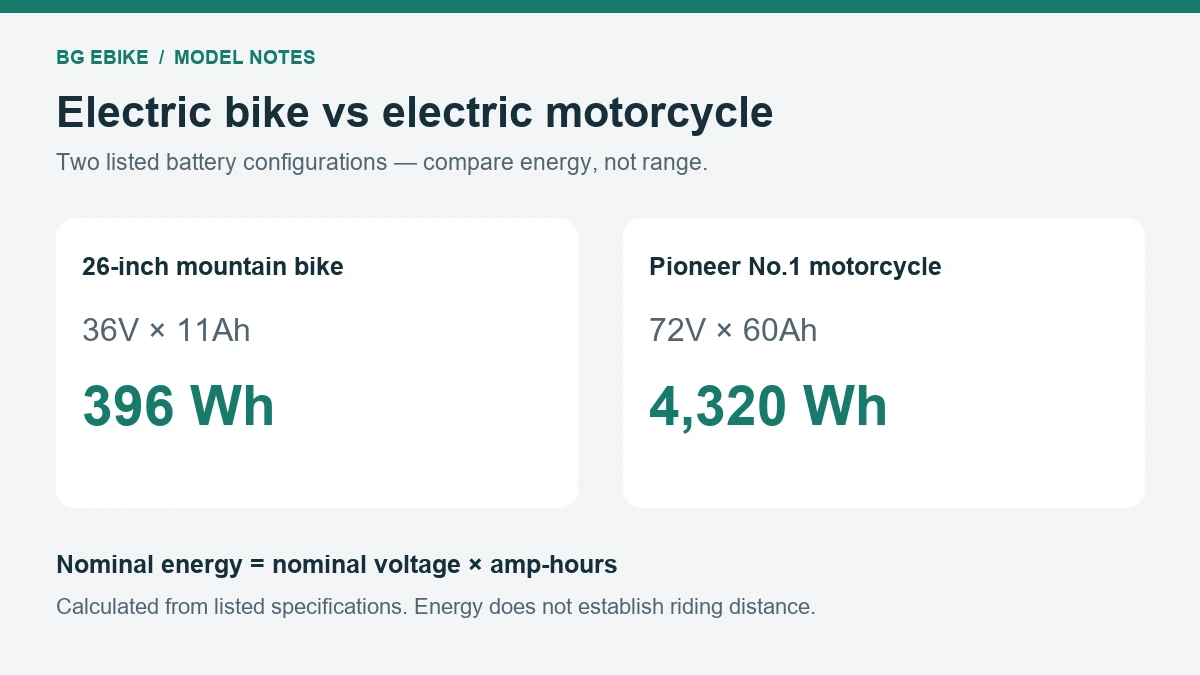
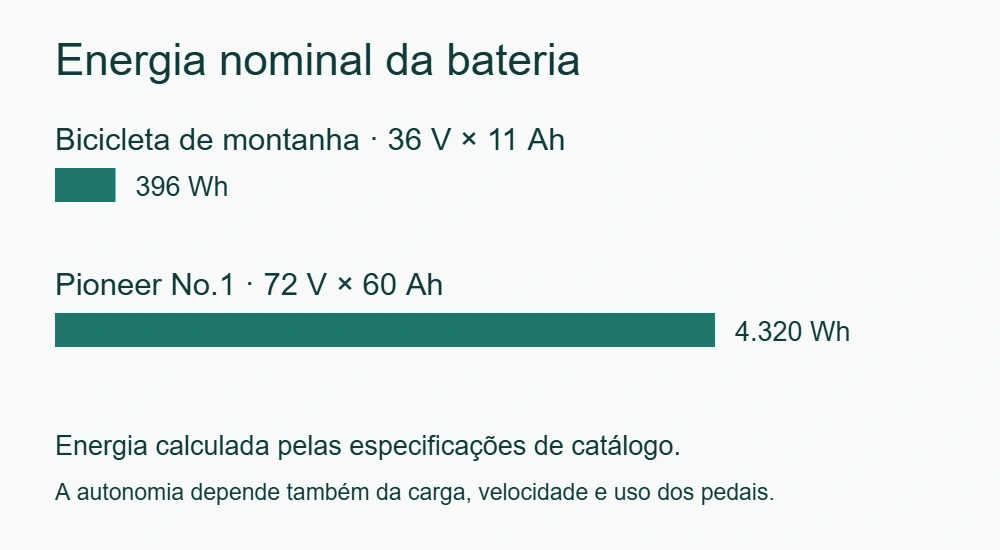
Nominal energy in Wh = nominal voltage × capacity in Ah. For the listed models above:
- The 26 Inch Electric Mountain Bike’s 36V 11Ah pack corresponds to 396Wh.
- Pioneer No.1’s 72V 60Ah pack corresponds to 4,320Wh, or 4.32kWh.
Those are calculations from the listed specifications. The second figure is about 10.9 times the first, but it does not establish 10.9 times the riding distance. Nor can voltage alone provide the missing energy figure for a 72V model: the selected Ah capacity is needed.
For a dealer comparison, record whether a distance claim used pedal assistance or motor-only travel, the load and the test speed. Keep the supplied charger and charging arrangement with each battery version. A larger energy figure is useful for understanding the specification, but it is not a promise of faster charging or longer range in every use.
Does a larger motor rating make one vehicle the better choice?
A larger advertised watt figure is not a complete performance comparison. Check whether the figure describes continuous motor output, peak output or electrical input before comparing it with another model.
Grin Technologies’ explanation of motor power ratings shows why battery, controller and operating conditions matter when interpreting motor-system figures. It also distinguishes electrical input from mechanical output.
M5 lists a 55A controller alongside a 72V system and a 3000W motor. Multiplying 72 by 55 gives 3,960, but that arithmetic is not a measurement of continuous mechanical motor output. Keep the controller specification and the motor rating in separate fields instead of relabelling the vehicle “3960W.”
For stock selection, compare the complete intended configuration and the performance information relevant to the buyer’s application. Do not substitute a higher motor number for evidence about braking, permitted load or sustained operation.
What must a dealer check before describing either vehicle as road legal?
Check the exact configuration and the destination’s requirements before making that claim. Product-category names, appearance and a set of pedals are not substitutes for the applicable classification and documents.
As a specific US example, 15 U.S.C. §2085(b) defines a low-speed electric bicycle using operable pedals, motor power below 750W and a motor-only speed below 20mph under its specified test conditions: a 170lb rider on a paved, level surface. This is a federal consumer-product definition, not a worldwide rule or a blanket answer about road access.
A vehicle outside that definition does not become approved for road use merely because a catalogue calls it an electric motorcycle. Record the destination and configuration with the classification review. The listed models in this guide are configuration examples, not a declaration that they meet a particular market’s road-use requirements.
How should a dealer compare costs?
Compare the complete supplied specification rather than assigning one price band to every e-bike and another to every motorcycle. Battery capacity and chemistry, chassis equipment, the charger, spare parts and packaging all belong in the quotation scope.
A quotation for a vehicle without its battery cannot be compared directly with one for a complete battery-equipped vehicle. Likewise, a lower vehicle price may leave a different parts or packaging requirement. Use the same destination and supply format when reviewing alternatives; the wholesale price guide explains the configuration details to include.
How should the differences change an order and spare-parts list?
Give every sellable configuration its own order line and component references. A shared colour, voltage or body style does not establish that chargers, controllers, brake parts or tyres can be exchanged.
- Vehicle: model, controls, motor specification, battery chemistry and capacity.
- Service parts: the approved references for the charger, controller, display, brakes and tyres; add bicycle drivetrain parts where fitted.
- Handling: weight of the supplied configuration, what that weight includes and the packed dimensions.
- Order: quantity per model and colour, destination and supply format.
At BG EBIKE, we produce and assemble electric vehicles in our own factory in Taizhou, China. MOQ is flexible by model, and models can be mixed in one container. That allows a buyer to discuss a range across categories while keeping each configuration identifiable. Review the electric bike range, electric motorcycle range and wholesale order arrangements alongside your shortlist.
For the physical handling comparison, the companion guide explains electric motorcycle weight, battery inclusion and shipping weight.
Frequently asked questions
Does having a throttle make an e-bike an electric motorcycle?
No, a throttle by itself does not establish the category. The US federal low-speed bicycle definition includes a motor-only speed test, alongside pedal and power requirements. Assess the complete configuration under the destination’s rules rather than classifying it from one control.
Is the heavier vehicle the one with the higher load capacity?
Not necessarily. Vehicle weight and permitted payload describe different things. A heavier frame, battery or body does not by itself prove a higher passenger or cargo allowance. Keep the defined load limit separate from the vehicle’s own weight when preparing a dealer specification.
Can one dealer carry both product categories?
Yes, if the range serves distinct customer needs and the dealer can support each supplied configuration. Keep product descriptions, component references and market documentation separate. Use demand and service capability to decide the assortment instead of adding similar-looking models without a clear role.
Basis: BG EBIKE’s listed model specifications, Grin Technologies’ motor-rating explanation and the linked US statutory example, reviewed on 16 November 2026. Battery-energy figures are calculations from nominal specifications.
When stocking electric bicycles alongside motorcycles, use the charger compatibility checklist to identify the approved charger for each battery version. For workshop planning, check battery placement and removal access before ordering service parts.
Build a comparable model shortlist
Send the models, quantity per model and colour, battery preferences, destination and intended use. Include the configuration or documentation requirements your market needs, so the quotation can address the actual vehicles you plan to sell.
Request a model comparison and quotation